Advertisements
Advertisements
प्रश्न
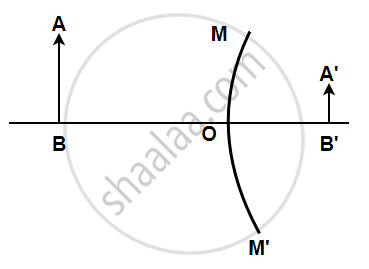
State whether the image in part (a) is real or virtual?
Advertisements
उत्तर
The image is virtual.
APPEARS IN
संबंधित प्रश्न
What happens when a ray of light falls normally (or perpendiculary) on the surface of a plane mirror?
What kind of mirror is required for obtaining a virtual image of the same size as the object?
Name the spherical mirror which can produce a virtual and diminished image of an object.
Write two more characteristics of the image.
A concave mirror forms a real image of an object placed in front of it at a distance 30 cm, of size three times the size of object. Find
- the focal length of mirror
- position of image.
Define the following term:
convex mirror
AB is the object, A1B1 is its image. MM' is the position of the mirror. Complete the ray diagram and find the position of the center of curvature and focus of the mirror. Also, measure the focal length.
An object is placed at a distance of 0.25 m
in front of a plane mirror. The distance between the object and image will be ______.
