Advertisements
Advertisements
प्रश्न
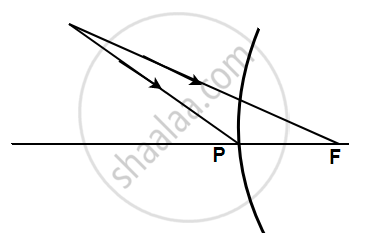
Write two more characteristics of the image.
Advertisements
उत्तर
The image formed is real and inverted.
APPEARS IN
संबंधित प्रश्न
Match the items given in Column I with one or more items of Column II.
| Column I | Column II | ||
| (a) | A plane mirror | (i) | Used as a magnifying glass. |
| (b) | A convex mirror | (ii) | Can form image of objects spread over a large area. |
| (c) | A convex lens | (iii) | Used by dentists to see enlarged image of teeth. |
| (d) | A concave mirror | (iv) | The image is always inverted and magnified. |
| (e) | A concave lens | (v) | The image is erect and of the same size as the object. |
| (vi) | The image is erect and smaller in size than the object. |
The diverging lens in part (a) is replaced by a converging lens also of focal length 100 mm. The object remains in the same position and an image is formed by the converging lens. Compare two properties of this image with those of the image formed by the diverging lens in part (a).
Write true or false
A virtual image formed by a spherical mirror is always erect and situated behind the mirror.
Why does a driver use a convex mirror instead of a plane mirror as a rear view mirror?
Illustrate your answer with the help of a ray diagram.
The erect image formed by a concave mirror is of size double the size of object. How are u and v related?
An object is placed at 4 cm distance in front of a concave mirror of radius of curvature 24 cm. Find the position of image. Is the image magnified?
The sun is seen before the sunrise and after the sunset.
Define the following term in relation to concave mirror.
Center of curvature
The boxes in figure (a, b, c) represent mirrors; insert a mirror which will reflect the incident ray as shown in the diagram.
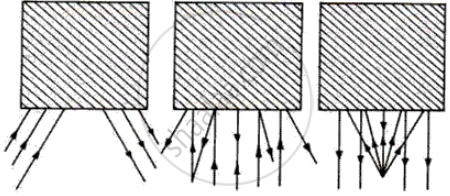
Complete the following diagrams shown in the following figures by drawing the reflected rays.