Advertisements
Advertisements
प्रश्न
The letter F is placed in front of a plane mirror:
What is the name of the phenomenon involved?
Advertisements
उत्तर
The phenomenon involved is lateral inversion.
संबंधित प्रश्न
Explain the following term related to spherical lenses:- principal axis
An image that cannot be obtained on a screen is called ______.
We can obtain a real, enlarged and inverted image by a concave mirror.
A ray of light is incident on a plane mirror at an angle of 30°. What is the angle of reflection
- A small object is placed 150 mm away from a diverging lens of focal length 100 mm.
- Copy the figure below and draw rays to show how an image is formed by the lens.
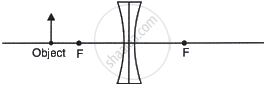
- Calculate the distance of the image from the lens by using the lens formula.
- Copy the figure below and draw rays to show how an image is formed by the lens.
- The diverging lens in part (a) is replaced by a converging lens also of focal length 100 mm. The object remains in the same position and an image is formed by the converging lens. Compare two properties of this image with those of the image formed by the diverging lens in part (a).
State the types of mirrors used for (i) headlights and (ii) rear view mirror, in cars and motorcycles. Give to justify your answer in each case.
State the two convenient rays that are chosen to construct the image by a spherical mirror for a given object? Explain your answer with the help of suitable ray diagrams.
State whether the image in part (a) is real or virtual?
State the kind of mirror used
(a) By a dentist,
(b) As a search-light reflector.
How will you distinguish between a plane mirror, a concave mirror and a convex mirror, without touching them?
The sun is seen before the sunrise and after the sunset.
An object forms a virtual image which is 1/8th of the size of the object. If the object is placed at a distance of 40 cm from the convex mirror, calculate:
- the position of the image
- the focal length of the convex mirror.
Define the following term in relation to concave mirror.
Principal axis
What is a mirror formula?
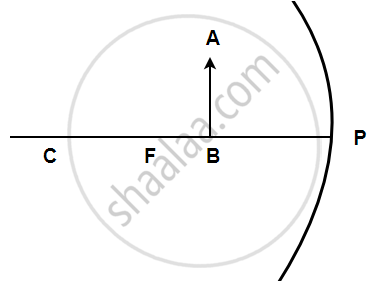
In the following figure shows a concave mirror with its pole (P), focus (F) and centre of curvature (C). Draw a ray diagram to show the formation of the image of an object AB by the concave mirror.
Define the term Pole.
