Advertisements
Advertisements
प्रश्न
The letter F is placed in front of a plane mirror:
What is the name of the phenomenon involved?
Advertisements
उत्तर
The phenomenon involved is lateral inversion.
संबंधित प्रश्न
Explain the following term related to spherical lenses:- principal axis
A ray of light is incident normally on a plane mirror. What will be the
angle of reflection?
When a spherical mirror is held towards the sun and its sharp image is formed on a piece of a carbon paper for some time, a hole is burnt in the carbon paper.
What name is given to the distance between spherical mirror and carbon paper?
How is a spherical mirror used to converge a beam of light at a point? Name the type of mirror used.
Explain the following term:
Incident ray
Draw diagram/diagrams to show them.
State the number of images of an object placed between two mirrors, formed in each case when mirrors are inclined to each other at (a) 90°, and (b) 60°.
Define the terms focus and focal length of a concave mirror. Draw diagram to illustrate your answer.
Name the mirror which always produces an erect and virtual image. How is the size of image related to the size of object?
State the kind of mirror used
(a) By a dentist,
(b) As a search-light reflector.
A real and enlarged image can be obtained by using a
Define the following term in relation to concave mirror.
Radius of curvature
Define the following term in relation to concave mirror.
Aperture
What do you understand by the term real image?
What is a mirror formula?
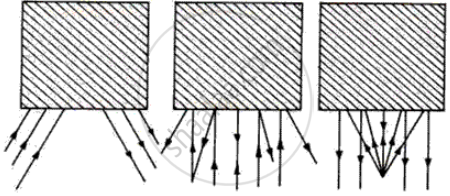
The boxes in figure (a, b, c) represent mirrors; insert a mirror which will reflect the incident ray as shown in the diagram.
The following Figure shows a concave mirror MM' on which a ray of light incident from a point P gets reflected to meet the principle axis at O.
(a) Find, by construction, the position of the centre of curvature of the concave mirror.
(b) Write down the value for the radius of curvature of the mirror.
(c) Calculate the focal length of the mirror.
(d ) Which relation is used in deducing the focal length from the radius of curvature?
If the focal length of a spherical mirror is 10 cm, what is the value of its radius of curvature?
If the real image of a candle flame formed by a lens is three times the size of the flame and the distance between lens and image is 80 cm, at what distance should the candle be placed from the lens?
