Advertisements
Advertisements
Question
The letter F is placed in front of a plane mirror:
What is the name of the phenomenon involved?
Advertisements
Solution
The phenomenon involved is lateral inversion.
RELATED QUESTIONS
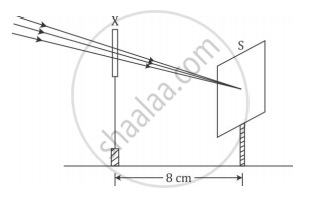
A student used a device (X) to obtain/focus the image of a well illuminated distant building on a screen (S) as shown below in the diagram. Select the correct statement about the device (X).
A 4 cm tall object is placed on the principal axis of a convex lens. The distance of the object from the optical centre of the lens is 12 cm and its sharp image is formed at a distance of 24 cm from it on a screen on the other side of the lens. If the object is now moved a little away from the lens, in which way (towards the lens or away from the lens) will he have to move the screen to get a sharp image of the object on it again? How will the magnification of the image be affected?
An image that cannot be obtained on a screen is called ______.
Name the two types of spherical mirrors. What type of mirror is represented by the:
- back side of a shining steel spoon?
- front side of a shining steel spoon?
What do you understand by the focus and focal length of a spherical mirror? Show them on the separate diagrams for each of a concave mirror and a convex mirror.
Which are the two convenient rays that are chosen to construct the image by a spherical mirror for a given object? Explain with the help of suitable ray diagrams.
A student obtained a sharp image of a burning candle, placed at the farther end of a laboratory table, on a screen using a concave mirror. For getting better value of focal length of the mirror, the subject teacher suggested him for focusing a well illuminated distant object. What should the student do?
(A) He should move the mirror away from the screen.
(B) He should move the mirror slightly towards the screen.
(C) He should move the mirror as well as the screen towards the newly selected object.
(D) He should move only the screen towards the newly selected object.
Name the two kinds of spherical mirrors and distinguish between them.
Define the terms focus and focal length of a concave mirror. Draw diagram to illustrate your answer.
Complete the following diagrams in Figure by drawing the reflected rays for the incident rays 1 and 2.
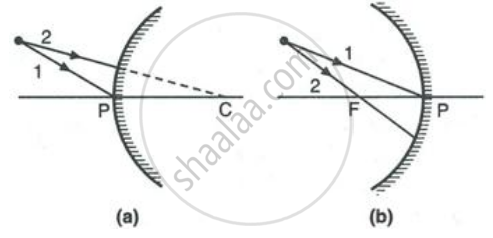
State whether the image in part (a) is real or virtual?
Discuss the position and nature of image formed by a concave mirror when an object is moved from infinity towards the pole of mirror.
How will you distinguish between a plane mirror, a concave mirror and a convex mirror, without touching them?
Draw a ray diagram to show the formation of image of an object kept in front of a convex mirror. State three characteristics of the image.
The image formed by a convex mirror is of size one third the size of object. How are u and v related?
Find the height of the image of a body of height 1.5m in a mirror with a magnification of 1.5.
The diagram below shows the parallel rays incident on a convex mirror. C is the centre of the curvature of the mirror. By drawing the paths of the reflected rays, label the focus F and hence find the focal length of the mirror.
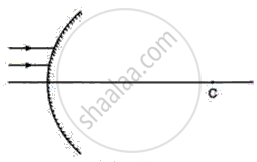
An object is placed at a distance of 0.25 m
in front of a plane mirror. The distance between the object and image will be ______.
