Advertisements
Advertisements
प्रश्न
The sun is seen before the sunrise and after the sunset.
Advertisements
उत्तर

EARLY SUNRISE and SUNSET: At sun Rise: When the Sun is just below the horizon, the light from the Sun suffers refraction from RARE to DENSER medium (As the atmosphere is warmer than layers near the earth at that time) bends towards the normal at each refraction. Due to continuous bending of light rays, the Sun can be seen even when its actual position is just below the Horizon. As a result, the Sun is seen in advance, two minutes before it rises above the horizon in the morning.
Similarly, in the evening Sun is seen delayed by 2 minutes longer above the horizon after the Sunset.
APPEARS IN
संबंधित प्रश्न
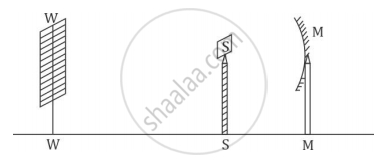
A student obtains a sharp image of the distant window (W) of the school laboratory on the screen (S) using the given concave mirror (M) to determine its focal length. Which of the following distances should he measure to get the focal length of the mirror?
Name the spherical mirror which can produce a real and diminished image of an object.
An optical device has been given to a student and he determines its focal length by focusing the image of the sun on a screen placed 24 cm from the device on the same side as the sun. Select the correct statement about the device.
(A) Convex mirror of focal length 12 cm
(B) Convex lens of focal length 24 cm
(C) Concave mirror of focal length 24 cm
(D) Convex lens of focal length 12 cm
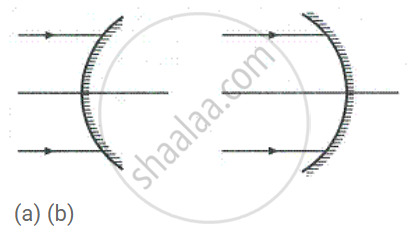
Name the mirrors shown in Figure (a) and (b).
Select the correct option:
A concave mirror is made by cutting a portion of a hollow glass sphere of radius 30 cm. The focal length of the concave mirror is:
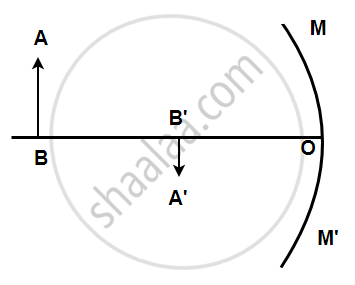
AB is the object, A'B' is the image, and MM' is the position of the mirror. Complete the ray diagram showing the formation of the image and find the focal length of the mirror.
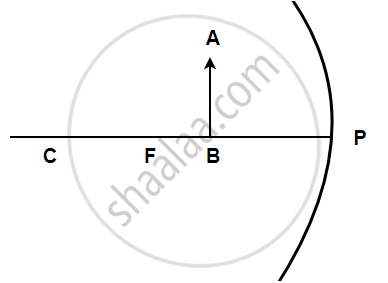
In the following figure shows a concave mirror with its pole (P), focus (F) and centre of curvature (C). Draw a ray diagram to show the formation of the image of an object AB by the concave mirror.
Which of the following has curved reflecting surface?
The spherical mirror used in a beauty parlour as make-up mirror is _______.
