Advertisements
Advertisements
प्रश्न
The shiny outer surface of a hollow sphere of aluminium of radius 50 cm is to be used as a mirror:
Which type of spherical mirror will it provide?
Advertisements
उत्तर
Since the outer surface is shiny, it will form a convex mirror.
APPEARS IN
संबंधित प्रश्न
An image formed by a ______ mirror is always of the same size as that of the object.
An image which can be obtained on a screen is called a ______ image.
Match the items given in Column I with one or more items of Column II.
| Column I | Column II | ||
| (a) | A plane mirror | (i) | Used as a magnifying glass. |
| (b) | A convex mirror | (ii) | Can form image of objects spread over a large area. |
| (c) | A convex lens | (iii) | Used by dentists to see enlarged image of teeth. |
| (d) | A concave mirror | (iv) | The image is always inverted and magnified. |
| (e) | A concave lens | (v) | The image is erect and of the same size as the object. |
| (vi) | The image is erect and smaller in size than the object. |
Which type of mirror can form a real image?
What is the name of the phenomenon in which the right side of an object appears to be the left side of the image in a plane mirror?
Write the formula for a lens connecting image distance (v), object distance (u) and the focal length (f). How does the lens formula differ from the mirror formula?
A ray of light travels from a denser medium to a rarer medium. How will it bend?
How is the focal length of a spherical mirror related to its radius
What is a spherical mirror?
Why does a driver use a convex mirror instead of a plane mirror as a rear view mirror?
Illustrate your answer with the help of a ray diagram.
Choose the correct alternative and rewrite the following:
Mirror used by a dental surgeon is ..........................
An object 5 cm high forms a virtual image of 1.25 cm high, when placed in front of a convex mirror at a distance of 24 cm. Calculate:
- the position of the image
- the focal length of the convex mirror.
Define the following term:
spherical mirror
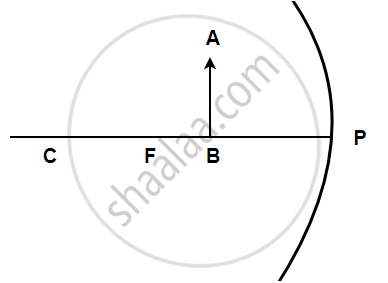
In the following figure shows a concave mirror with its pole (P), focus (F) and centre of curvature (C). Draw a ray diagram to show the formation of the image of an object AB by the concave mirror.
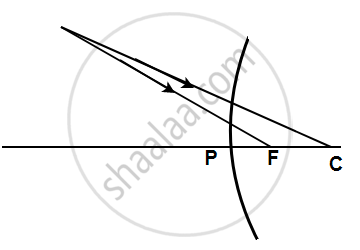
Complete the following diagrams shown in the below figure by drawing the reflected ray for each incident ray.
Define the term Pole.
Define focal length.
Assertion: Incident ray is directed towards the centre of curvature of spherical mirror. After reflection it retraces its path.
Reason: Angle of incidence (i) = Angle of reflection (r) = 0°
If the real image of a candle flame formed by a lens is three times the size of the flame and the distance between lens and image is 80 cm, at what distance should the candle be placed from the lens?
Explain why a ray of light passing through the center of curvature of a concave mirror, gets reflected along with the same pattern.
