Advertisements
Advertisements
Question
The sun is seen before the sunrise and after the sunset.
Advertisements
Solution

EARLY SUNRISE and SUNSET: At sun Rise: When the Sun is just below the horizon, the light from the Sun suffers refraction from RARE to DENSER medium (As the atmosphere is warmer than layers near the earth at that time) bends towards the normal at each refraction. Due to continuous bending of light rays, the Sun can be seen even when its actual position is just below the Horizon. As a result, the Sun is seen in advance, two minutes before it rises above the horizon in the morning.
Similarly, in the evening Sun is seen delayed by 2 minutes longer above the horizon after the Sunset.
APPEARS IN
RELATED QUESTIONS
AB and CD, two spherical mirrors, from parts of a hollow spherical ball with its centre at O as shown in the diagram. If arc AB = `1/2` arc CD, what is the ratio of their focal lengths? State which of the two mirrors will always form virtual image of an object placed in front of it and why.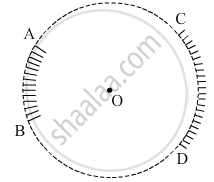
The letters on the front of an ambulance are written laterally inverted like  . Give reason.
Name the mirror which always produces an erect and virtual image. How is the size of image related to the size of object?
Name the kind of mirror used to obtain :
A real and enlarged image
For an incident ray directed towards centre of curvature of a spherical mirror the reflected ray:
Select the correct option:
A mirror forms a virtual image (diminished) of an object, whatever be the position of object:
A ray of light is incident towards a plane mirror at an angle of 30° with the mirror surface. What will be the angle of reflection?
