Advertisements
Advertisements
Question
AB and CD, two spherical mirrors, from parts of a hollow spherical ball with its centre at O as shown in the diagram. If arc AB = `1/2` arc CD, what is the ratio of their focal lengths? State which of the two mirrors will always form virtual image of an object placed in front of it and why.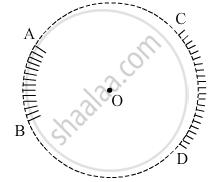
Advertisements
Solution
The ratio of the focal lengths of mirrors AB and CD will be equal to one, as both mirrors are part of the same spherical ball. Hence, their radius of curvature and focal length will be the same.
The mirror AB will always form a virtual image when an object is placed in front of it because the mirror AB is a convex mirror.
APPEARS IN
RELATED QUESTIONS
Explain the following term related to spherical lenses:- principal axis
Explain the following term related to spherical lenses:- principal focus
Define Radius of curvature of the spherical mirror
A ray of light is incident on a plane mirror at an angle of 30°. What is the angle of reflection
A 2.0 cm tall object is placed 40 cm from a diverging lens of focal length 15 cm. Find the position and size of the image.
Which are the two convenient rays that are chosen to construct the image by a spherical mirror for a given object? Explain with the help of suitable ray diagrams.
For what position of object, the image formed by a concave mirror is magnified and erect?
Why does a driver use a convex mirror instead of a plane mirror as a rear view mirror?
Illustrate your answer with the help of a ray diagram.
Select the correct option:
Looking into a mirror one finds her image diminished, the mirror is:
Visit a nearby hospital. You can also visit the clinic of an ENT specialist, or a dentist. Request the doctor to show you the mirrors used for examining ear, nose, throat and teeth. Can you recognise the kind of mirror used in these instruments?
