Advertisements
Advertisements
प्रश्न
AB and CD, two spherical mirrors, from parts of a hollow spherical ball with its centre at O as shown in the diagram. If arc AB = `1/2` arc CD, what is the ratio of their focal lengths? State which of the two mirrors will always form virtual image of an object placed in front of it and why.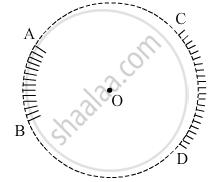
Advertisements
उत्तर
The ratio of the focal lengths of mirrors AB and CD will be equal to one, as both mirrors are part of the same spherical ball. Hence, their radius of curvature and focal length will be the same.
The mirror AB will always form a virtual image when an object is placed in front of it because the mirror AB is a convex mirror.
APPEARS IN
संबंधित प्रश्न
A ray of light travels from a denser medium to a rarer medium. How will it bend?
What do you mean by the term dispersion?
State the two kinds of spherical mirror and distinguish them with the aid of proper diagrams.
Define the terms pole, principal axis and centre of curvature with reference to a spherical mirror.
Name the spherical mirror which (i) diverges (ii) converges the beam of light incident on it. Justify your answer by drawing a ray diagram in each case.
Figure shows a concave mirror with its pole at P, focus F and centre of curvature C. Draw ray diagram to show the formation of image of an object OA.
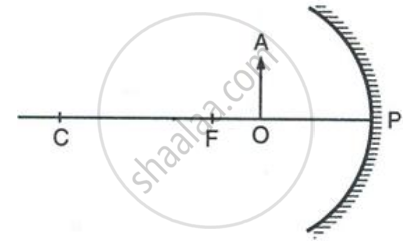
Name the kind of mirror used to obtain :
A real and enlarged image
Select the correct option:
A concave mirror is made by cutting a portion of a hollow glass sphere of radius 30 cm. The focal length of the concave mirror is:
An object 10 cm high is placed at a distance of 20 cm in front of a spherical mirror of focal length 25 cm. By scale drawing find the nature, position, and magnification of the image in the following case:
Convex mirror
For a spherical mirror, ______ is true.
