Advertisements
Advertisements
प्रश्न
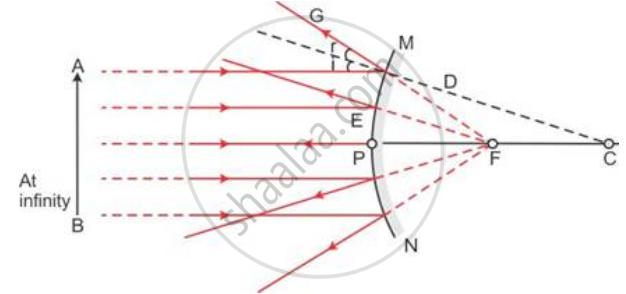
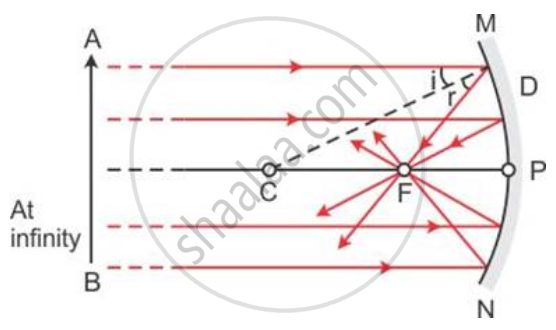
Name the spherical mirror which (i) diverges (ii) converges the beam of light incident on it. Justify your answer by drawing a ray diagram in each case.
Advertisements
उत्तर
(i) Convex mirror diverges a beam of light falling on it.
(ii) Concave mirror converges a beam of light falling on it.
APPEARS IN
संबंधित प्रश्न
A 4 cm tall object is placed on the principal axis of a convex lens. The distance of the object from the optical centre of the lens is 12 cm and its sharp image is formed at a distance of 24 cm from it on a screen on the other side of the lens. If the object is now moved a little away from the lens, in which way (towards the lens or away from the lens) will he have to move the screen to get a sharp image of the object on it again? How will the magnification of the image be affected?
Explain the following term related to spherical lenses:- principal axis
Explain the following term related to spherical lenses:- aperture
Name the spherical mirror which has:
(a) virtual principal focus.
(b) real principal focus.
When a spherical mirror is held towards the sun and its sharp image is formed on a piece of a carbon paper for some time, a hole is burnt in the carbon paper.
At which point of the spherical mirror the carbon paper is placed?
A diverging lens is used in ______.
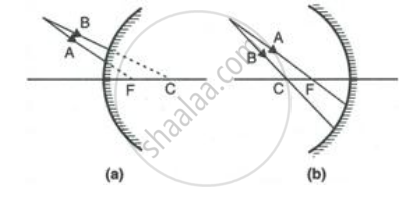
Complete the following diagrams shown in Fig. by drawing the reflected ray for each of the incident ray A and B.
Upto what maximum distance from the pole the image in a convex mirror can be obtained? what will be the location of object then ?
At what distance from a concave mirror of focal length 25 cm should an object be placed so that the size of image is equal to the size of the object.
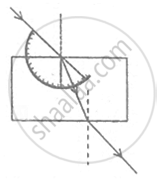
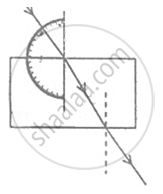
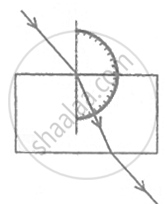
A student traces the path of a ray of light passing through a rectangular slab.
 |
 |
 |
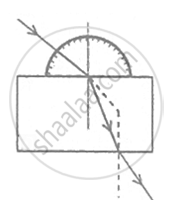 |
For measuring the angle of incidence, he must position the protractor in the manner shown in the figure:
