Advertisements
Advertisements
प्रश्न
A small object is placed 150 mm away from a diverging lens of focal length 100 mm.
(i) Copy the figure below and draw rays to show how an image is formed by the lens.
Figure
(ii) Calculate the distance of the image from the lens by using the lens formula.
Advertisements
उत्तर
The image formed by the lens is virtual, erect and diminished in size.
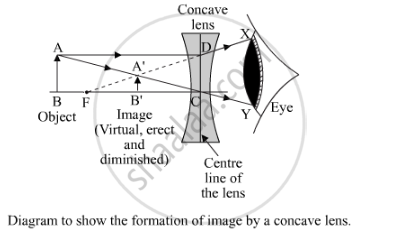
(a)(ii) Object distance (u) = -150 mm = -15 cm (sign convention)
Focal length (f) = -100 mm = -10 cm (sign convention)
Image distance (v) = ?
Applying the lens formula, we have:
`1/v-1/u=1/f`
`1/v-1/-15=1/-10`
`1/v+1/15=-1/10`
`1/v=1/10-1/15`
`1/v=(-3-2)/30`
`1/v=(-5)/30`
`v=-6 cm `
APPEARS IN
संबंधित प्रश्न
A student focused the Sun rays using an optical device 'X' on a screen S as shown.
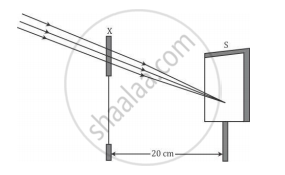
From this it may be concluded that the device 'X' is a (select the correct option)
(A) Convex lens of focal length 10 cm.
(B) Convex lens of radius of curvature 20 cm.
(C) Convex lens of focal length 20 cm.
(D) Concave mirror of focal length 20 cm.
An image that cannot be obtained on a screen is called ______.
Name the spherical mirror which has:
(a) virtual principal focus.
(b) real principal focus.
Name the two types of spherical mirrors. What type of mirror is represented by the:
front side of a shining steel spoon?
A coin placed at the bottom of a vessel appears to be raised when water is poured in the vessel.
State the two kinds of spherical mirror and distinguish them with the aid of proper diagrams.
Three mirrors are created from a single sphere. Which of the following - pole, centre of curvature, radius of curvature, principal axis - will be common to them and which will not be common?
A real and enlarged image can be obtained by using a
At what distance from a concave mirror of focal length 25 cm should an object be placed so that the size of image is equal to the size of the object.
Find the height of the image of a body of height 1.5m in a mirror with a magnification of 1.5.
Define the term Focus of a concave mirror.
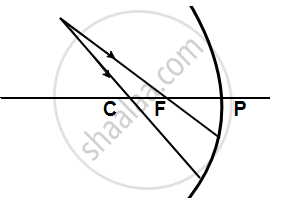
Complete the following diagrams shown in the below figure by drawing the reflected ray for each incident ray.
If the focal length of a spherical mirror is 10 cm, what is the value of its radius of curvature?
Numerical problem.
The radius of curvature of a spherical mirror is 25 cm. Find its focal length.
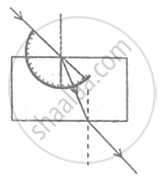
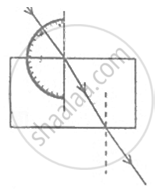
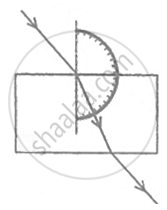
A student traces the path of a ray of light passing through a rectangular slab.
 |
 |
 |
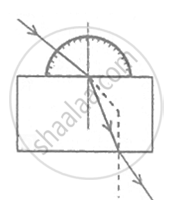 |
For measuring the angle of incidence, he must position the protractor in the manner shown in the figure:
What is the focal length (f) of a mirror?
Define the following terms in the context of a diverging mirror:
- Principal focus
- Focal length
Draw a labelled ray diagram to illustrate your answer.
