Advertisements
Advertisements
Question
- A small object is placed 150 mm away from a diverging lens of focal length 100 mm.
- Copy the figure below and draw rays to show how an image is formed by the lens.
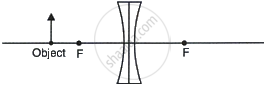
- Calculate the distance of the image from the lens by using the lens formula.
- Copy the figure below and draw rays to show how an image is formed by the lens.
- The diverging lens in part (a) is replaced by a converging lens also of focal length 100 mm. The object remains in the same position and an image is formed by the converging lens. Compare two properties of this image with those of the image formed by the diverging lens in part (a).
Diagram
Numerical
Advertisements
Solution
a. i. The image formed by the lens is virtual, erect and diminished in size.
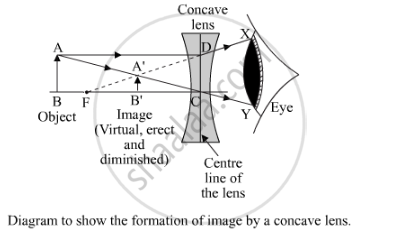
ii. Object distance (u) = −150 mm = −15 cm (sign convention)
Focal length (f) = −100 mm = −10 cm (sign convention)
Image distance (v) = ?
By using the lens formula:
`1/v - 1/u = 1/f`
`1/v - 1/-15 = 1/-10`
`1/v + 1/15 = -1/10`
`1/v = 1/10-1/15`
`1/v = (-3-2)/30`
`1/v = (-5)/30`
v = −6 cm
b.
| Property | Image by diverging lens (Part a) | Image by converging lens (Part b) |
| Nature of image | Virtual and Erect (formed on the same side as the object) | Real and Inverted (formed on the opposite side of the lens) |
| Size/Magnification | Diminished (magnification is 0.4, making the image smaller) | Magnified / Enlarged (magnification is −2, making the image twice the size) |
shaalaa.com
Is there an error in this question or solution?
