Advertisements
Advertisements
Question
Which type of mirror can form a real image?
Advertisements
Solution
- A concave mirror can form a real image of an object.
- The nature of the image depends on the object's distance from the concave mirror.
APPEARS IN
RELATED QUESTIONS
What is the name of the phenomenon in which the right side of an object appears to be the left side of the image in a plane mirror?
A 2.0 cm tall object is placed 40 cm from a diverging lens of focal length 15 cm. Find the position and size of the image.
The focal length of a concave mirror is 10 cm. Find its radius of curvature.
The magnification for a mirror is -3. How are u and v related?
An object 5 cm high forms a virtual image of 1.25 cm high, when placed in front of a convex mirror at a distance of 24 cm. Calculate:
- the position of the image
- the focal length of the convex mirror.
Define the following term in relation to concave mirror.
Aperture
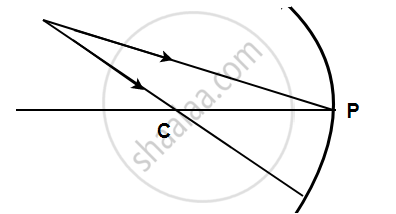
Complete the following diagrams shown in the following figures by drawing the reflected rays.
A ray of light is incident towards a plane mirror at an angle of 30° with the mirror surface. What will be the angle of reflection?
What is “aperture”?
