Advertisements
Advertisements
Question
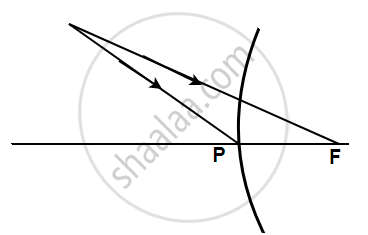
Complete the following diagrams shown in the following figures by drawing the reflected rays.
Advertisements
Solution

A light ray when produced backwards passes through principal focus as shown in the problem figure. We draw the normal through the centre of curvature at the point of incidence and draw the reflected ray at an angle equal to the angle of incidence thus following the laws of reflection. The reflected ray is parallel to the principal axis. The other ray is reflected at the pole by an angle in accordance with the laws of reflection. These two reflected rays when produced backwards coincide at a point where the image is formed. The image, A'B' is virtual, erect, and diminished in size
APPEARS IN
RELATED QUESTIONS
A ray of light is incident normally on a plane mirror. What will be the
angle of reflection?
Name the spherical mirror which can produce a real and diminished image of an object.
The diverging lens in part (a) is replaced by a converging lens also of focal length 100 mm. The object remains in the same position and an image is formed by the converging lens. Compare two properties of this image with those of the image formed by the diverging lens in part (a).
Name the spherical mirror which (i) diverges (ii) converges the beam of light incident on it. Justify your answer by drawing a ray diagram in each case.
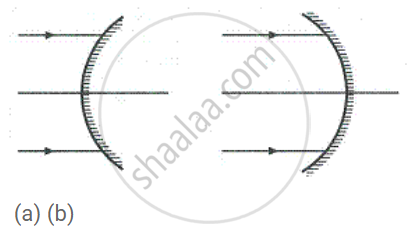
In each case (a) and (b), draw reflected rays for the given incident rays and mark focus by the symbol F.
What type of mirror can be used to obtain a real image of an object?
The focal length of a concave mirror is 10 cm. Find its radius of curvature.
Does the mirror name by your form a real image for all locations? Give a reason for your answer.
Name the two types of spherical mirrors.
