Advertisements
Advertisements
प्रश्न
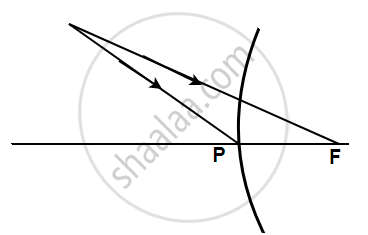
Complete the following diagrams shown in the following figures by drawing the reflected rays.
Advertisements
उत्तर

A light ray when produced backwards passes through principal focus as shown in the problem figure. We draw the normal through the centre of curvature at the point of incidence and draw the reflected ray at an angle equal to the angle of incidence thus following the laws of reflection. The reflected ray is parallel to the principal axis. The other ray is reflected at the pole by an angle in accordance with the laws of reflection. These two reflected rays when produced backwards coincide at a point where the image is formed. The image, A'B' is virtual, erect, and diminished in size
APPEARS IN
संबंधित प्रश्न
Explain the following term related to spherical lenses:- optical centre
Image formed by a convex ______ is always virtual and smaller in size.
What type of image is formed:
on a cinema screen?
A concave lens produces an image 20 cm from the lens of an object placed 30 cm from the lens. The focal length of the lens is:
(a) 50 cm
(b) 40 cm
(c) 60 cm
(d) 30 cm
When an object of height 1 cm is kept at a distance 4 cm from a concave mirror, its erect image of height 1.5 cm is formed at a distance 6 cm behind the mirror. Find the focal length of mirror, by drawing.
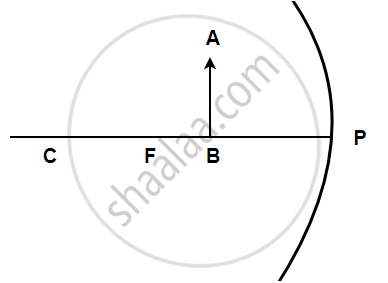
In the following figure shows a concave mirror with its pole (P), focus (F) and centre of curvature (C). Draw a ray diagram to show the formation of the image of an object AB by the concave mirror.
Draw a ray diagram to show that a convex mirror has a wider field of view.
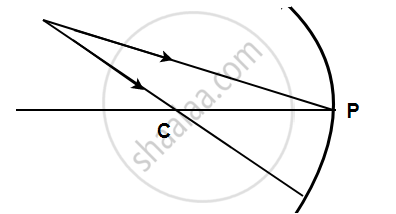
Complete the following diagrams shown in the following figures by drawing the reflected rays.
Geometric centre of the spherical mirror is ______.
