Advertisements
Advertisements
प्रश्न
Advertisements
उत्तर
Linear magnification is defined as the ratio of the height of the image to the height of the object. It is taken to be positive for an image to be virtual and erect and negative when image is real and inverted.
Magnification = height of image / height of object.
APPEARS IN
संबंधित प्रश्न
Explain the following term related to spherical lenses:- optical centre
A concave mirror always forms a real image.
State the two kinds of spherical mirror and distinguish them with the aid of proper diagrams.
Select the correct option:
A mirror forms a virtual image (diminished) of an object, whatever be the position of object:
Define the term Normal.
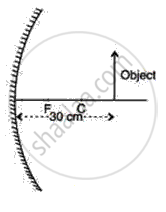
An object is placed in front of a concave mirror as shown in the following figure. By scale drawing, find the nature of the image. Given f = 10 cm, v = 30 cm.
Spherical mirrors are one form of ______ mirrors.
Define the radius of curvature.
