In the case of the convex mirror, all rays incident parallel to the principal axis appears to diverge from a Focal point. So it has a wider field of view as it converges all rays to a single point.
Advertisements
प्रश्न
Draw a ray diagram to show that a convex mirror has a wider field of view.
Advertisements
उत्तर
In the case of a convex mirror, all rays incident parallel to the principal axis appears to diverge from a Focal point. So it has a wider field of view as it converges all rays to a single point.

APPEARS IN
संबंधित प्रश्न
A student focused the Sun rays using an optical device 'X' on a screen S as shown.
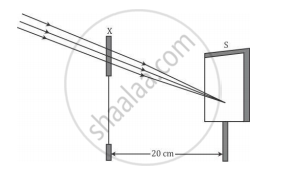
From this it may be concluded that the device 'X' is a (select the correct option)
(A) Convex lens of focal length 10 cm.
(B) Convex lens of radius of curvature 20 cm.
(C) Convex lens of focal length 20 cm.
(D) Concave mirror of focal length 20 cm.
A ray of light strikes a plane mirror at an angle of 40° to the mirror surface. What will be the angle of reflection?
A ray of light is incident normally on a plane mirror. What will be the:
- angle of incidence?
- angle of reflection?
When a spherical mirror is held towards the sun and its sharp image is formed on a piece of a carbon paper for some time, a hole is burnt in the carbon paper.
What is the advantage of using a carbon paper rather than a white paper?
State whether the image in part (a) is real or virtual?
Write the spherical mirror's formula and explain the meaning of each symbol used in it.
A spherical mirror whose reflecting surface is curved outwards is called ______ mirror.
A converging lens of focal length f is placed at a distance 0.3 m from an object to produce an image on a screen 0.9 m from the lens. With the object and the screen in the same positions, an image of the object could also be produced on the screen by placing a converging lens of focal length.
