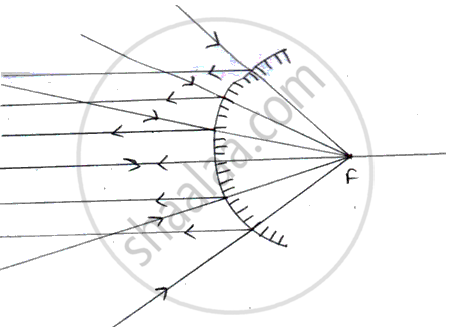
In the case of the convex mirror, all rays incident parallel to the principal axis appears to diverge from a Focal point. So it has a wider field of view as it converges all rays to a single point.
Advertisements
प्रश्न
Draw a ray diagram to show that a convex mirror has a wider field of view.
Advertisements
उत्तर
In the case of a convex mirror, all rays incident parallel to the principal axis appears to diverge from a Focal point. So it has a wider field of view as it converges all rays to a single point.
APPEARS IN
संबंधित प्रश्न
Define the following term in the context of spherical mirrors:- Pole
Define the following term in the context of spherical mirrors:- Principal focus
Define (a) centre of curvature (b) radius of curvature (c) pole (d) principal axis, and (e) aperture, of a spherical mirror with the help of a labelled diagram
Explain the following term:
Incident ray
Draw diagram/diagrams to show them.
What is meant by magnification? Write its expression. What is its sign for the (a) real (b) virtual, image?
When an object of height 1 cm is kept at a distance 4 cm from a concave mirror, its erect image of height 1.5 cm is formed at a distance 6 cm behind the mirror. Find the focal length of mirror, by drawing.
An object 10 cm high is placed at a distance of 20 cm in front of a spherical mirror of focal length 25 cm. By scale drawing find the nature, position, and magnification of the image in the following case:
Convex mirror
The following Figure shows a concave mirror MM' on which a ray of light incident from a point P gets reflected to meet the principle axis at O.
(a) Find, by construction, the position of the centre of curvature of the concave mirror.
(b) Write down the value for the radius of curvature of the mirror.
(c) Calculate the focal length of the mirror.
(d ) Which relation is used in deducing the focal length from the radius of curvature?
