Advertisements
Advertisements
प्रश्न
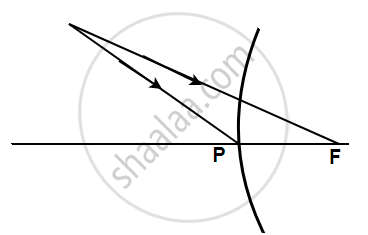
Complete the following diagrams shown in the following figures by drawing the reflected rays.
Advertisements
उत्तर

A light ray when produced backwards passes through principal focus as shown in the problem figure. We draw the normal through the centre of curvature at the point of incidence and draw the reflected ray at an angle equal to the angle of incidence thus following the laws of reflection. The reflected ray is parallel to the principal axis. The other ray is reflected at the pole by an angle in accordance with the laws of reflection. These two reflected rays when produced backwards coincide at a point where the image is formed. The image, A'B' is virtual, erect, and diminished in size
APPEARS IN
संबंधित प्रश्न
Which type of mirror can form a real image?
Write the formula for a lens connecting image distance (v), object distance (u) and the focal length (f). How does the lens formula differ from the mirror formula?
A diverging lens is used in ______.
Write true or false
A virtual image formed by a spherical mirror is always erect and situated behind the mirror.
Select the correct option:
A concave mirror is made by cutting a portion of a hollow glass sphere of radius 30 cm. The focal length of the concave mirror is:
Define the following term in relation to concave mirror.
Principal focus
Draw a ray diagram to show that a convex mirror has a wider field of view.
What is “aperture”?
