Advertisements
Advertisements
प्रश्न
State one practical use of a concave mirror.
Advertisements
उत्तर
- Concave mirrors are used in reflecting microscopes.
- Concave mirrors are used in shaving.
- Concave mirrors are used in makeup glasses.
- Concave mirrors are used in an ophthalmoscope.
Notes
Students should refer to the answer according to their questions.
संबंधित प्रश्न
Explain the following term related to spherical lenses:- principal focus
Match the items given in Column I with one or more items of Column II.
| Column I | Column II | ||
| (a) | A plane mirror | (i) | Used as a magnifying glass. |
| (b) | A convex mirror | (ii) | Can form image of objects spread over a large area. |
| (c) | A convex lens | (iii) | Used by dentists to see enlarged image of teeth. |
| (d) | A concave mirror | (iv) | The image is always inverted and magnified. |
| (e) | A concave lens | (v) | The image is erect and of the same size as the object. |
| (vi) | The image is erect and smaller in size than the object. |
Define (a) centre of curvature (b) radius of curvature (c) pole (d) principal axis, and (e) aperture, of a spherical mirror with the help of a labelled diagram
The shiny outer surface of a hollow sphere of aluminium of radius 50 cm is to be used as a mirror:
What will be the focal length of this mirror?
The shiny outer surface of a hollow sphere of aluminium of radius 50 cm is to be used as a mirror:
- What will be the focal length of this mirror?
- Which type of spherical mirror will it provide?
- State whether this spherical mirror will diverge or converge light rays.
A concave lens produces an image 20 cm from the lens of an object placed 30 cm from the lens. The focal length of the lens is:
(a) 50 cm
(b) 40 cm
(c) 60 cm
(d) 30 cm
A ray of light travels from a denser medium to a rarer medium. How will it bend?
Explain the following term:
Incident ray
Draw diagram/diagrams to show them.
Name the mirror which always produces an erect and virtual image. How is the size of image related to the size of object?
Which mirror will you prefer to use as a rear view mirror in a car : plane mirror or convex mirror? Give one reason.
The magnification for a mirror is -3. How are u and v related?
An object of length 4 cm is placed in front of a concave mirror at distance 30 cm. The focal length of mirror is 15 cm.
- Where will the image form?
- What will be the length of image?
Choose the correct alternative and rewrite the following:
Mirror used by a dental surgeon is ..........................
What is the relation between focal length and radius of curvature of a concave mirror?
What do you understand by the term real image?
Complete the following diagrams shown in the below figure by drawing the reflected ray for each incident ray.
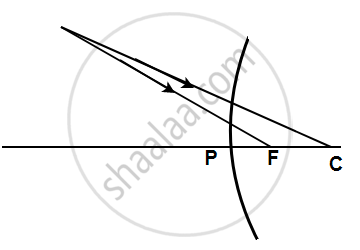
Define the term Focus of a concave mirror.
Define the term Normal.
Draw a ray diagram to show that a convex mirror has a wider field of view.
An object is placed in front of a concave mirror as shown in the following figure. By scale drawing, find the nature of the image. Given f = 10 cm, v = 30 cm.
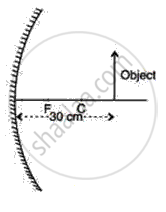
Size of image of an object by a mirror having a focal length of 20 cm is observed to be reduced to 1/3rd of its size. At what distance the object has been placed from the mirror? What is the nature of the image and the mirror?
How tall does a mirror have to be to fit an entire person’s body?
What is the focal length (f) of a mirror?
What is “aperture”?
