Advertisements
Advertisements
प्रश्न
State one practical use of a concave mirror.
Advertisements
उत्तर
- Concave mirrors are used in reflecting microscopes.
- Concave mirrors are used in shaving.
- Concave mirrors are used in makeup glasses.
- Concave mirrors are used in an ophthalmoscope.
Notes
Students should refer to the answer according to their questions.
संबंधित प्रश्न
An image which can be obtained on a screen is called a ______ image.
What happens when a ray of light falls normally (or perpendiculary) on the surface of a plane mirror?
When a spherical mirror is held towards the sun and its sharp image is formed on a piece of a carbon paper for some time, a hole is burnt in the carbon paper.
Why is a hole burnt in the carbon paper?
A diverging lens is used in ______.
- A small object is placed 150 mm away from a diverging lens of focal length 100 mm.
- Copy the figure below and draw rays to show how an image is formed by the lens.
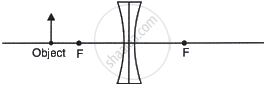
- Calculate the distance of the image from the lens by using the lens formula.
- Copy the figure below and draw rays to show how an image is formed by the lens.
- The diverging lens in part (a) is replaced by a converging lens also of focal length 100 mm. The object remains in the same position and an image is formed by the converging lens. Compare two properties of this image with those of the image formed by the diverging lens in part (a).
A ray of light travels from a denser medium to a rarer medium. How will it bend?
Explain the following terms :
Pole, Centre of curvature, Radius of curvature, Principal axis. Show them on separate diagrams for each of the concave and convex mirrors.
How is a spherical mirror used to diverge a beam of light from a point? Name the type of mirror used.
State the number of images of an object placed between two mirrors, formed in each case when mirrors are inclined to each other at (a) 90°, and (b) 60°.
State the two convenient rays that are chosen to construct the image by a spherical mirror for a given object? Explain your answer with the help of suitable ray diagrams.
Draw a ray diagram to show the formation of image by a concave mirror for an object placed between its pole and focus. State three characteristics of the image.
What is meant by magnification? Write its expression. What is its sign for the (a) real (b) virtual, image?
How will you distinguish between a plane mirror, a concave mirror and a convex mirror, without touching them?
The radius of curvature of a convex mirror is 40 cm. Find its focal length.
The image formed by a convex mirror is of size one third the size of object. How are u and v related?
An object forms a virtual image which is 1/8th of the size of the object. If the object is placed at a distance of 40 cm from the convex mirror, calculate:
- the position of the image
- the focal length of the convex mirror.
Define the following term in relation to concave mirror.
Focal length
What is the relationship between the focal length and radius of curvature?
Define the term Principle focus.
Which of the following has curved reflecting surface?
Name the type of mirror used in the following situation:
Side/rear-view mirror of a vehicle
Support your answer with reason.
Name the type of mirror used in the following situation:
Solar furnace
Support your answer with reason.
The radius of curvature of a spherical mirror is 18 cm. What is the focal length of this mirror?
How tall does a mirror have to be to fit an entire person’s body?
Define the following terms in the context of a diverging mirror:
- Principal focus
- Focal length
Draw a labelled ray diagram to illustrate your answer.
