Advertisements
Advertisements
प्रश्न
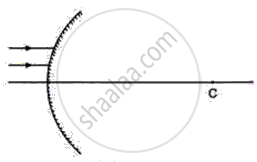
The diagram below shows the parallel rays incident on a convex mirror. C is the centre of the curvature of the mirror. By drawing the paths of the reflected rays, label the focus F and hence find the focal length of the mirror.
Advertisements
उत्तर

We know when the incident ray is parallel to the principal axis then they appear to diverge from a point F.
Geometrically we can find this value and this comes to 2 cm. Centre of curvature = 4 cm.
Focal length = centre of curvature/2.
APPEARS IN
संबंधित प्रश्न
One half of a convex lens of focal length 10 cm is covered with a black paper. Can such a lens produce an image of a complete object placed at a distance of 30 cm from the lens? Draw a ray diagram to justify your answer. A 4 cm tall object is placed perpendicular to its principal axis of a convex lens of focal length 20 cm. The distance of the object from the lens is 15 cm. Find the nature, position and the size of the image.
What is a virtual image?
What happens when a ray of light falls normally (or perpendiculary) on the surface of a plane mirror?
What is a spherical mirror?
Is real image always inverted?
Numerical problem.
The radius of curvature of a spherical mirror is 25 cm. Find its focal length.
Name the type of mirror used in the following situation:
Side/rear-view mirror of a vehicle
Support your answer with reason.
