Advertisements
Advertisements
Questions
State one practical use of a concave mirror.
Advertisements
Solution
- Concave mirrors are used in reflecting microscopes.
- Concave mirrors are used in shaving.
- Concave mirrors are used in makeup glasses.
- Concave mirrors are used in an ophthalmoscope.
Notes
Students should refer to the answer according to their questions.
RELATED QUESTIONS
Define the following terms in the context of spherical mirrors :
(i) Pole
(ii) Centre of curvature
(iii) Radius of curvature
(iv) Principal axis
Define the terms pole, principal axis and centre of curvature with reference to a spherical mirror.
The image formed by a convex mirror is
Define the following term in relation to concave mirror.
Principal focus
An object 10 cm high is placed at a distance of 20 cm in front of a spherical mirror of focal length 25 cm. By scale drawing find the nature, position, and magnification of the image in the following case:
Concave mirror
The spherical mirror used as a rear view mirror in the vehicle is
Numerical problem.
The radius of curvature of a spherical mirror is 25 cm. Find its focal length.
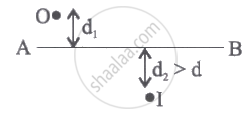
In the figure shown, the image of a real object is formed at the point I. AB is the principal axis of the mirror. The mirror must be: