Advertisements
Advertisements
Question
Advertisements
Solution
APPEARS IN
RELATED QUESTIONS
A 4 cm tall object is placed on the principal axis of a convex lens. The distance of the object from the optical centre of the lens is 12 cm and its sharp image is formed at a distance of 24 cm from it on a screen on the other side of the lens. If the object is now moved a little away from the lens, in which way (towards the lens or away from the lens) will he have to move the screen to get a sharp image of the object on it again? How will the magnification of the image be affected?
The shiny outer surface of a hollow sphere of aluminium of radius 50 cm is to be used as a mirror:
- What will be the focal length of this mirror?
- Which type of spherical mirror will it provide?
- State whether this spherical mirror will diverge or converge light rays.
AB and CD, two spherical mirrors, from parts of a hollow spherical ball with its centre at O as shown in the diagram. If arc AB = `1/2` arc CD, what is the ratio of their focal lengths? State which of the two mirrors will always form virtual image of an object placed in front of it and why.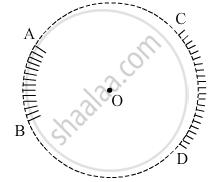
How will you distinguish between a plane mirror, a concave mirror and a convex mirror, without touching them?
A straight stick partly dipped in water obliquely appears to be bent at the surface of the water.
Define the following term:
spherical mirror
Define the term principal focus in case of convex mirror. Draw a convex mirror and show its principal focus and focal length clearly.
The distance from the center of curvature of the mirror to the pole is called the focal length of the mirror.
How tall does a mirror have to be to fit an entire person’s body?
What is “aperture”?
