Advertisements
Advertisements
Question
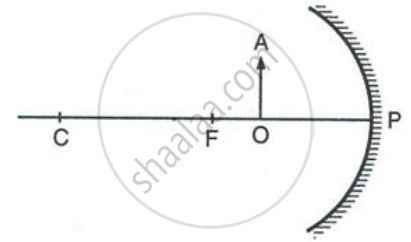
Does the mirror name by your form a real image for all locations? Give a reason for your answer.
Advertisements
Solution
No, this mirror does not give a real image of the object that lies between principal focus and pole.
APPEARS IN
RELATED QUESTIONS
Explain the following term related to spherical lenses:- optical centre
Image formed by a convex ______ is always virtual and smaller in size.
Define the Focal length of a spherical mirror
What kind of mirror is required for obtaining a virtual image of the same size as the object?
The diverging lens in part (a) is replaced by a converging lens also of focal length 100 mm. The object remains in the same position and an image is formed by the converging lens. Compare two properties of this image with those of the image formed by the diverging lens in part (a).
Explain the following term:
Incident ray
Draw diagram/diagrams to show them.
Figure shows a concave mirror with its pole at P, focus F and centre of curvature C. Draw ray diagram to show the formation of image of an object OA.
What type of mirror can be used to obtain a real image of an object?
Define the following term in relation to concave mirror.
Radius of curvature
Define the term Principle focus.
