Advertisements
Advertisements
Question
An object of length 4 cm is placed in front of a concave mirror at distance 30 cm. The focal length of mirror is 15 cm.
- Where will the image form?
- What will be the length of image?
Advertisements
Solution
O = 4 cm
u = -30 cm
f = -15 cm
From mirror formula ,
`1/"f" = 1/"v" + 1/"u"`
∴ `1/"v" = 1/"f" - 1/"u"`
∴ `1/"v" = 1/(-15) - 1/(-30) = 1/30 - 1/15`
∴ `1/"v" = (-1)/30`
∴ v = -30 cm
Hence , the image is formed at a distance of 30 cm in front of the mirror .
m = `-"v"/"u" = "I"/"O"`
∴ I = `"-OV"/"u" = (-4 xx -30)/(-30) = -4`cm
Negative sign indicates inverted image.
So, I = 4 cm
Hence , the length of the image is 4 cm.
APPEARS IN
RELATED QUESTIONS
The shiny outer surface of a hollow sphere of aluminium of radius 50 cm is to be used as a mirror:
Which type of spherical mirror will it provide?
State the types of mirrors used for (i) headlights and (ii) rear view mirror, in cars and motorcycles. Give to justify your answer in each case.
Complete the following diagrams in Figure by drawing the reflected rays for the incident rays 1 and 2.
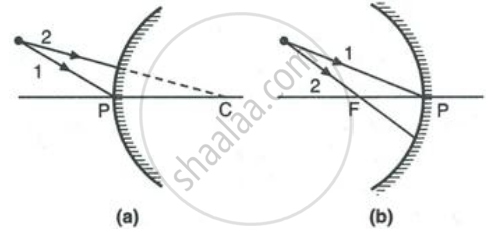
Write two more characteristics of the image.
What is the relationship between the focal length and radius of curvature?
The distance from the pole to the focus is called ______.
Define the radius of curvature.
Define the following terms in the context of a diverging mirror:
- Principal focus
- Focal length
Draw a labelled ray diagram to illustrate your answer.
