Advertisements
Advertisements
Question
What is the relation between the focal length and radius of curvature of a spherical mirror (concave mirror or convex mirror)?
Advertisements
Solution
The relation between the focal length and radius of curvature of a spherical mirror is as follows:
Radius of curvature = 2 × focal length
R = 2f
APPEARS IN
RELATED QUESTIONS
A ray of light strikes a plane mirror at an angle of 40° to the mirror surface. What will be the angle of reflection?
Define the terms focus and focal length of a concave mirror. Draw diagram to illustrate your answer.
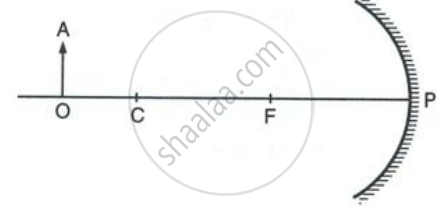
Figure shows a concave mirror with its pole at P, focus F and centre of curvature C. Draw ray diagram to show the formation of image of an object OA.
How is the focal length of a spherical mirror related to its radius of curvature?
What is meant by magnification? Write its expression. What is its sign for the (a) real (b) virtual, image?
(a) When a concave mirror is used as a shaving mirror, where is the person's face in relation to the focus of mirror?
(b) State three characteristics of the image seen in part (a).
How will you distinguish between a plane mirror, a concave mirror and a convex mirror, without touching them?
An object of height 2 cm is placed at a distance of 20 cm in front of a concave mirror of a focal length of 12 cm. Find the position, size, and nature of the image.
A straight stick partly dipped in water obliquely appears to be bent at the surface of the water.
The sun is seen before the sunrise and after the sunset.
Draw a ray diagram to show the formation of the image, when the object is placed between optical centre and principal focus of a convex lens.
State the signs and values of magnifications in the above mentioned case.
An object 5 cm high forms a virtual image of 1.25 cm high, when placed in front of a convex mirror at a distance of 24 cm. Calculate:
- the position of the image
- the focal length of the convex mirror.
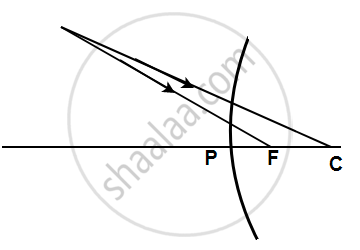
Complete the following diagrams shown in the below figure by drawing the reflected ray for each incident ray.
An object 10 cm high is placed at a distance of 20 cm in front of a spherical mirror of focal length 25 cm. By scale drawing find the nature, position, and magnification of the image in the following case:
Concave mirror
