Advertisements
Advertisements
Question
Name the kind of mirror used to obtain
(a) a real and enlarged image
(b) a virtual and enlarged image
(c) a real and diminished image, and
(d) a virtual and diminished image.
Advertisements
Solution
a) Concave
b) Concave
c) Concave
d) Convex
APPEARS IN
RELATED QUESTIONS
Draw separate diagram for the formation of virtual image of an object by a concave mirror.
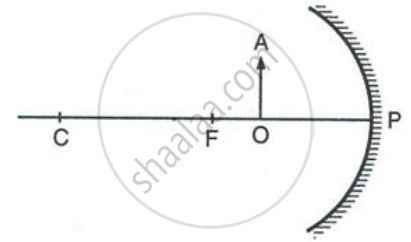
Figure shows a concave mirror with its pole at P, focus F and centre of curvature C. Draw ray diagram to show the formation of image of an object OA.
Discuss the position and nature of image formed by a concave mirror when an object is moved from infinity towards the pole of mirror.
State two uses of a concave mirror.
An object is placed at 4 cm distance in front of a concave mirror of radius of curvature 24 cm. Find the position of image. Is the image magnified?
Define the following term:
convex mirror
Define the following term in relation to concave mirror.
Principal focus
Geometric centre of the spherical mirror is ______.
Name the type of mirror used in the following situation:
Side/rear-view mirror of a vehicle
Support your answer with reason.
The distance from the center of curvature of the mirror to the pole is called the focal length of the mirror.
