Advertisements
Advertisements
Questions
State two uses of a concave mirror.
Give the uses of a concave mirror.
Advertisements
Solution 1
Two uses of concave mirror:
(i) It is used as a shaving mirror.
(ii) It is used as reflector in torch, head light of automobiles etc.
Solution 2
The uses of a concave mirror are
(i) In torches and headlights: The source of light is placed at the focus to obtain a parallel beam of light.
(ii) In floodlights: The source of light is placed just beyond the center of curvature so as to get an intense beam of light.
(iii) Reflecting mirrors for projector lamps: The object is placed at the center of curvature to obtain an image of the same size.
- To collect heat radiations in solar devices: Heat radiations from the sum coming from infinity are brought to focus by a concave mirror in its focal plane.
- Shaving mirror, dentist’s mirror: It produces an erect virtual and highly magnified image of an object placed between its pole and focus.
vi. Solar furnaces: Large concave mirrors are used to concentrate sunlight to produce heat in a solar furnace.
APPEARS IN
RELATED QUESTIONS
An image that cannot be obtained on a screen is called ______.
What type of image is formed:
on a cinema screen?
What kind of mirror is required for obtaining a virtual image of the same size as the object?
What is the name of the phenomenon in which the right side of an object appears to be the left side of the image in a plane mirror?
When a spherical mirror is held towards the sun and its sharp image is formed on a piece of carbon paper for some time, a hole is burnt in the carbon paper.
- What is the nature of spherical mirror?
- Why is a hole burnt in the carbon paper?
- At which point of the spherical mirror the carbon paper is placed?
- What name is given to the distance between spherical mirror and carbon paper?
- What is the advantage of using a carbon paper rather than a white paper?
A 50 cm tall object is at a very large distance from a diverging lens. A virtual, erect and diminished image of the object is formed at a distance of 20 cm in front of the lens. How much is the focal length of the lens?
- A small object is placed 150 mm away from a diverging lens of focal length 100 mm.
- Copy the figure below and draw rays to show how an image is formed by the lens.
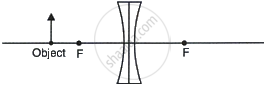
- Calculate the distance of the image from the lens by using the lens formula.
- Copy the figure below and draw rays to show how an image is formed by the lens.
- The diverging lens in part (a) is replaced by a converging lens also of focal length 100 mm. The object remains in the same position and an image is formed by the converging lens. Compare two properties of this image with those of the image formed by the diverging lens in part (a).
A ray of light travels from a denser medium to a rarer medium. How will it bend?
How is the focal length of a spherical mirror related to its radius
If a spherical mirror breaks, what type of mirrors are the individual pieces?
Define the terms pole, principal axis and centre of curvature with reference to a spherical mirror.
Figure shows a concave mirror with its pole at P, focus F and centre of curvature C. Draw ray diagram to show the formation of image of an object OA.
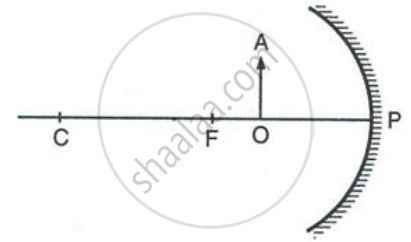
For what position of object, the image formed by a concave mirror is magnified and erect?
What type of mirror can be used to obtain a real image of an object?
Does the mirror mentioned in part (b) form real image for all locations of the object?
How is the focal length of a spherical mirror related to its radius of curvature?
Define the following term:
concave mirror
Define the following term in relation to concave mirror.
Aperture
Define the term Focus of a concave mirror.
An object 10 cm high is placed at a distance of 20 cm in front of a spherical mirror of focal length 25 cm. By scale drawing find the nature, position, and magnification of the image in the following case:
Concave mirror
Name the two types of spherical mirrors.
What is “aperture”?
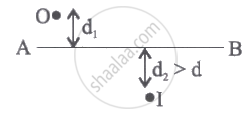
In the figure shown, the image of a real object is formed at the point I. AB is the principal axis of the mirror. The mirror must be:
In normal adjustment, for a refracting telescope, the distance between objective and eye piece is 30 cm. The focal length of the objective, when the angular magnification of the telescope is 2, will be ______.
