Advertisements
Advertisements
प्रश्न
State two uses of a concave mirror.
Give the uses of a concave mirror.
Advertisements
उत्तर १
Two uses of concave mirror:
(i) It is used as a shaving mirror.
(ii) It is used as reflector in torch, head light of automobiles etc.
उत्तर २
The uses of a concave mirror are
(i) In torches and headlights: The source of light is placed at the focus to obtain a parallel beam of light.
(ii) In floodlights: The source of light is placed just beyond the center of curvature so as to get an intense beam of light.
(iii) Reflecting mirrors for projector lamps: The object is placed at the center of curvature to obtain an image of the same size.
- To collect heat radiations in solar devices: Heat radiations from the sum coming from infinity are brought to focus by a concave mirror in its focal plane.
- Shaving mirror, dentist’s mirror: It produces an erect virtual and highly magnified image of an object placed between its pole and focus.
vi. Solar furnaces: Large concave mirrors are used to concentrate sunlight to produce heat in a solar furnace.
APPEARS IN
संबंधित प्रश्न
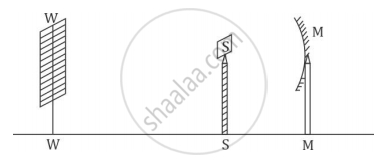
A student obtains a sharp image of the distant window (W) of the school laboratory on the screen (S) using the given concave mirror (M) to determine its focal length. Which of the following distances should he measure to get the focal length of the mirror?
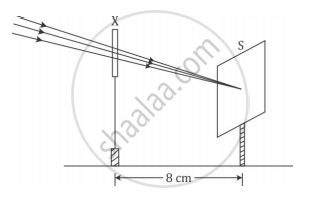
A student used a device (X) to obtain/focus the image of a well illuminated distant building on a screen (S) as shown below in the diagram. Select the correct statement about the device (X).
Define the following term in the context of spherical mirrors:- Principal focus
Explain the following term related to spherical lenses: focal length
We can obtain an enlarged and erect image by a convex mirror.
Give one use each of a concave and a convex mirror.
A ray of light is incident on a plane mirror at an angle of 30°. What is the angle of reflection
What kind of mirror is required for obtaining a virtual image of the same size as the object?
The letter F is placed in front of a plane mirror:
What is the name of the phenomenon involved?
Name the two types of spherical mirrors. What type of mirror is represented by the:
- back side of a shining steel spoon?
- front side of a shining steel spoon?
Name the two types of spherical mirrors. What type of mirror is represented by the:
front side of a shining steel spoon?
When a spherical mirror is held towards the sun and its sharp image is formed on a piece of a carbon paper for some time, a hole is burnt in the carbon paper.
At which point of the spherical mirror the carbon paper is placed?
The diverging lens in part (a) is replaced by a converging lens also of focal length 100 mm. The object remains in the same position and an image is formed by the converging lens. Compare two properties of this image with those of the image formed by the diverging lens in part (a).
How is a spherical mirror used to diverge a beam of light from a point? Name the type of mirror used.
Explain the meaning of the terms focus and focal length in case of a convex mirror, with the help of suitable ray diagram.
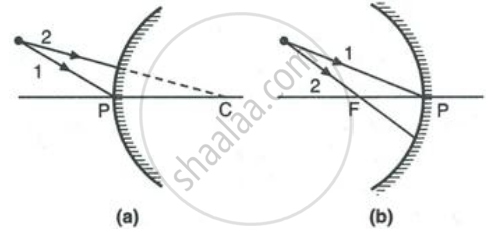
Complete the following diagrams in Figure by drawing the reflected rays for the incident rays 1 and 2.
What type of mirror can be used to obtain a real image of an object?
Upto what maximum distance from the pole the image in a convex mirror can be obtained? what will be the location of object then ?
When an object of height 1 cm is kept at a distance 4 cm from a concave mirror, its erect image of height 1.5 cm is formed at a distance 6 cm behind the mirror. Find the focal length of mirror, by drawing.
The sun is seen before the sunrise and after the sunset.
Define the following term:
spherical mirror
Define the following term in relation to concave mirror.
Radius of curvature
What is a mirror formula?
Define the term Pole.
The spherical mirror used as a rear view mirror in the vehicle is
What is the difference between virtual images of an object formed by a concave mirror and a convex mirror?
For a spherical mirror, ______ is true.
