Advertisements
Advertisements
प्रश्न
State two uses of a concave mirror.
Give the uses of a concave mirror.
Advertisements
उत्तर १
Two uses of concave mirror:
(i) It is used as a shaving mirror.
(ii) It is used as reflector in torch, head light of automobiles etc.
उत्तर २
The uses of a concave mirror are
(i) In torches and headlights: The source of light is placed at the focus to obtain a parallel beam of light.
(ii) In floodlights: The source of light is placed just beyond the center of curvature so as to get an intense beam of light.
(iii) Reflecting mirrors for projector lamps: The object is placed at the center of curvature to obtain an image of the same size.
- To collect heat radiations in solar devices: Heat radiations from the sum coming from infinity are brought to focus by a concave mirror in its focal plane.
- Shaving mirror, dentist’s mirror: It produces an erect virtual and highly magnified image of an object placed between its pole and focus.
vi. Solar furnaces: Large concave mirrors are used to concentrate sunlight to produce heat in a solar furnace.
APPEARS IN
संबंधित प्रश्न
Define the following term in the context of spherical mirrors:- Pole
Explain the following term related to spherical lenses:- centres of curvature
An image which can be obtained on a screen is called a ______ image.
Name the two types of spherical mirrors. What type of mirror is represented by the:
- back side of a shining steel spoon?
- front side of a shining steel spoon?
When a spherical mirror is held towards the sun and its sharp image is formed on a piece of a carbon paper for some time, a hole is burnt in the carbon paper.
What is the advantage of using a carbon paper rather than a white paper?
A 50 cm tall object is at a very large distance from a diverging lens. A virtual, erect and diminished image of the object is formed at a distance of 20 cm in front of the lens. How much is the focal length of the lens?
The diverging lens in part (a) is replaced by a converging lens also of focal length 100 mm. The object remains in the same position and an image is formed by the converging lens. Compare two properties of this image with those of the image formed by the diverging lens in part (a).
How is a spherical mirror used to diverge a beam of light from a point? Name the type of mirror used.
The letters on the front of an ambulance are written laterally inverted like  . Give reason.
The diagram below in Figure, shows a convex mirror. C is its centre of curvature and F is its focus. (i) Draw two rays from A and hence locate the position of image of object OA. Label the image IB. (ii) State three characteristics of the image.
Draw a ray diagram to show the formation of image by a concave mirror for the object beyond its centre of curvature. State three characteristics of the image.
For what position of object, the image formed by a concave mirror is magnified and erect?
State whether the image in part (a) is real or virtual?
Upto what maximum distance from a concave mirror, the image can be obtained? What will be the location of object for it?
For an incident ray directed towards centre of curvature of a spherical mirror the reflected ray:
Choose the correct alternative and rewrite the following:
Mirror used by a dental surgeon is ..........................
Define the following term in relation to concave mirror.
Radius of curvature
Define the following term in relation to concave mirror.
Aperture
Is real image always inverted?
Define the term Aperture.
An object 10 cm high is placed at a distance of 20 cm in front of a spherical mirror of focal length 25 cm. By scale drawing find the nature, position, and magnification of the image in the following case:
Concave mirror
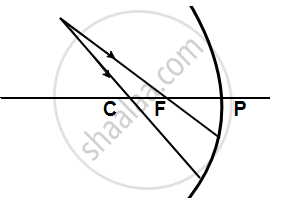
Complete the following diagrams shown in the below figure by drawing the reflected ray for each incident ray.
Name the type of mirror used in the following situation:
Side/rear-view mirror of a vehicle
Support your answer with reason.
In normal adjustment, for a refracting telescope, the distance between objective and eye piece is 30 cm. The focal length of the objective, when the angular magnification of the telescope is 2, will be ______.
