Advertisements
Advertisements
प्रश्न
Define the following terms in the context of spherical mirrors :
(i) Pole
(ii) Centre of curvature
(iii) Radius of curvature
(iv) Principal axis
Advertisements
उत्तर

(i) Pole of a spherical mirror
The central point of the reflecting surface of a spherical mirror is termed as the pole. It lies on the mirror and is denoted by the letter (P).
(ii) Centre of curvature
The centre of curvature is the centre of a sphere from which the given spherical mirror (convex or concave) is obtained. It is denoted by the letter (C).
(iii) Radius of curvature
The distance between the centre of curvature and pole (PC) is known as the radius of curvature.
(iv) Principal axis
The imaginary straight line joining the pole (P) and the centre of curvature (C) is termed as the principal axis.
APPEARS IN
संबंधित प्रश्न
Explain the following term related to spherical lenses: focal length
We can obtain an enlarged and erect image by a convex mirror.
Match the items given in Column I with one or more items of Column II.
| Column I | Column II | ||
| (a) | A plane mirror | (i) | Used as a magnifying glass. |
| (b) | A convex mirror | (ii) | Can form image of objects spread over a large area. |
| (c) | A convex lens | (iii) | Used by dentists to see enlarged image of teeth. |
| (d) | A concave mirror | (iv) | The image is always inverted and magnified. |
| (e) | A concave lens | (v) | The image is erect and of the same size as the object. |
| (vi) | The image is erect and smaller in size than the object. |
The letter F is placed in front of a plane mirror:
What is the name of the phenomenon involved?
Name the mirror which always produces an erect and virtual image. How is the size of image related to the size of object?
Name the kind of mirror used to obtain :
A real and enlarged image
Define the following term in relation to concave mirror.
Center of curvature
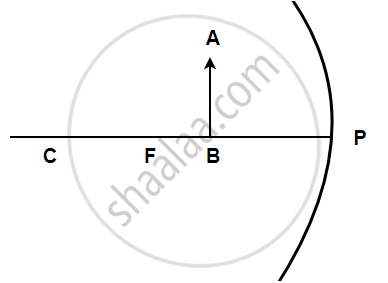
In the following figure shows a concave mirror with its pole (P), focus (F) and centre of curvature (C). Draw a ray diagram to show the formation of the image of an object AB by the concave mirror.
Define focal length.
