Advertisements
Advertisements
प्रश्न
In the following diagram, the correctly marked angles are
(A) All
(B) Only ∠i and ∠A
(C) ∠i, ∠r and ∠A
(D) ∠i, ∠A and ∠D
Advertisements
उत्तर
Angle i by conventions represents the angle of incidence which is formed between the incident ray and the normal. From the given figure it is clear that angle i is correctly marked.
Angle r by convention represents angle of refraction which is formed between the refracted ray and the normal. From the given figure it is clear that angle r is correctly marked.
Angle e by convention represents angle of emergent which is formed between the emergent ray and the normal. But in the given figure it is shown between the emergent ray and the incident ray. Therefore, it is incorrectly marked.
Angle D by conventions represents the angle of deviation which is formed between the emergent ray and the incident ray. But in the given figure it is shown between the emergent ray and the normal. Therefore, it is incorrectly marked.
Angle A represents angle of prism and it is correctly marked.
Hence, the correct answer is option (C).
APPEARS IN
संबंधित प्रश्न
In the figure given alongside, a narrow beam of white light is shown to pass through a triangular glass prism. After passing through the prism, it produces a spectrum YX on the screen.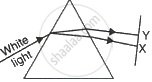
- State the colour seen
- at X, and
- at Y.
- Why do different colours of white light bend through different angles with respect to the incident beam of light?
The property of splitting of white light into its seven constituent colours is known as
A ray of white light falls on a prism. Draw a ray diagram to show that the prism disperses the white light.
You are given a disc divided into seven sectors with colours violet, indigo, blue, green, yellow, orange and red in them. What would be its colour when it is rotated rapidly?
What conclusion do you draw about the nature of white light in part (b)?
In an experiment to trace the path of a ray of light through a glass prism for different values of angle of incidence a student would find that the emergent ray:
(A) is parallel to the incident ray
(B) perpendicular to the incident ray
(C) is parallel to the refracted ray
(D) bends at an angle to the direction of incident ray
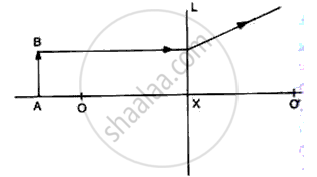
Refer to fig
(i) Name the lens L.
(ii) What are the points O, O' called?
(iii) Complete the diagram to form the image of the object AB.
(iv) Write three characteristics of the image.
Suggest one way, in each case, by which we can detect the presence of Infrared radiations.
Write an Explanation.
Critical angle
What is dispersion? Explain in detail.
