Advertisements
Advertisements
प्रश्न
What conclusion do you draw about the nature of white light in part (b)?
Advertisements
उत्तर
We conclude that white light is polychromatic.
संबंधित प्रश्न
In the figure given alongside, a narrow beam of white light is shown to pass through a triangular glass prism. After passing through the prism, it produces a spectrum YX on the screen.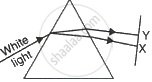
- State the colour seen
- at X, and
- at Y.
- Why do different colours of white light bend through different angles with respect to the incident beam of light?
What are the seven colours seen in a rainbow?
Out of the following, the colour of light having the maximum wavelength is:
(a) violet
(b) indigo
(c) green
(d) orange
State the speed of light in (a) air, (b) water, and (c) glass
What do you understand by the term spectrum?
A ray of white light is passed through a glass prism and a spectrum is obtained on a screen.
- Name the seven colours of the spectrum in order.
- Do the colours have the same width in the spectrum?
- Which of the colour of the spectrum of white light deviates (i) the most, (ii) the least?
In the following diagram, the correctly marked angles are
(A) All
(B) Only ∠i and ∠A
(C) ∠i, ∠r and ∠A
(D) ∠i, ∠A and ∠D
Draw a labeled ray diagram to illustrate the dispersion of a narrow beam of white light when it passes through a glass prism.
Distinguish between an impure spectrum and a pure spectrum.
