Advertisements
Advertisements
प्रश्न
In an experiment to trace the path of a ray of light through a glass prism for different values of angle of incidence a student would find that the emergent ray:
(A) is parallel to the incident ray
(B) perpendicular to the incident ray
(C) is parallel to the refracted ray
(D) bends at an angle to the direction of incident ray
Advertisements
उत्तर
(D)
As the light gets refracted two times at different angles, the emergent ray bends at an angle to the direction of incident ray.
APPEARS IN
संबंधित प्रश्न
The path of a ray of light passing through a glass prism is shown below:
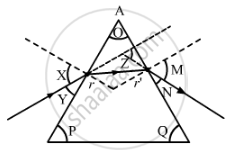
In this diagram, the angle of prism, angle of incidence, angle of emergence and angle of deviation, respectively, have been represented by:
(A) O, Y, Z and N,
(B) P, Y, M and Z,
(C) O, X, M and Z,
(D) P, X, Z and N.
What will happen if another similar glass prism is placed upside down behind the first prism?
The property of splitting of white light into its seven constituent colours is known as
Draw a labelled diagram: Dispersion of light through a prism.
Say TRUE or FALSE
Rainbow is formed by dispersion of which light by water drops
Name the scientist who was the first to use a glass prism to obtain the spectrum of sunlight.
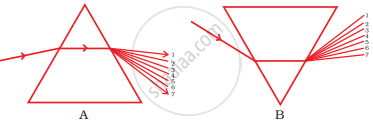
State the correct sequence (1-7) of colours in the spectrum formed by the prisms A and B, shown in the following figure.
Which one of the following is involved for the formation of rainbow in the sky?
The dispersive powers of flint glass and crown glass are 0.053 and 0.034, respectively and their mean refractive indices are 1.68 and 1.53 for white light. Calculate the angle of the flint glass prism required to form an achromatic combination with a crown glass prism of refracting angle 4°:
A ray of light is incident at 45° on an equilateral prism in the diagram below.

- Name the phenomenon exhibited by the ray of light when it enters and emerges out of the prism.
- State the cause of the above phenomenon mentioned by you.
