Advertisements
Advertisements
प्रश्न
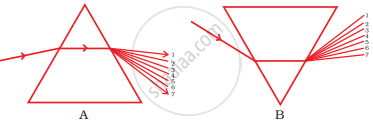
State the correct sequence (1-7) of colours in the spectrum formed by the prisms A and B, shown in the following figure.
Advertisements
उत्तर
In figure A and figure B
| Figure A | Colour | Figure B |
| 1 | Red | 7 |
| 2 | Orange | 6 |
| 3 | Yellow | 5 |
| 4 | Green | 4 |
| 5 | Blue | 3 |
| 6 | Indigo | 2 |
| 7 | Violet | 1 |
APPEARS IN
संबंधित प्रश्न
What is a rainbow?
The splitting of white light into its constituent colours is called .............
If a monochromatic beam of light undergoes minimum deviation through an equiangular prism, how does the beam pass through the prism, with respect to its base?
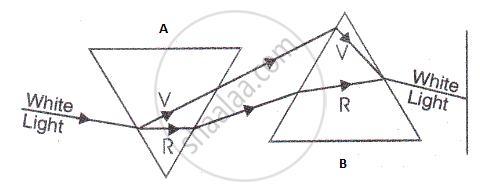
Complete the ray diagram given below to show the nature of light produced on the screen.
The completed ray diagram is as shown below:
Which characteristic property of light is responsible for the blue colour of the sky?
Write the range of wavelength of the ultraviolet spectrum.
Write an Explanation.
Critical angle
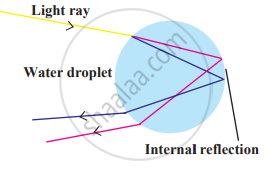
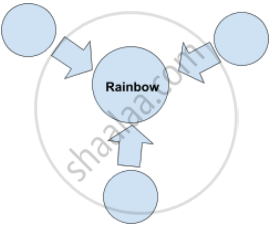
Rainbow is a beautiful natural phenomenon. It is the combined effect of a natural three processes together produced by light. Write it into the circle.
Name the scientist who was the first to use a glass prism to obtain the spectrum of sunlight.
______ colour is deviated the least in the spectrum of white light obtained with a glass prism.
