Advertisements
Advertisements
प्रश्न
The splitting of white light into its constituent colours is called .............
Advertisements
उत्तर
The splitting of white light into its constituent colours is called dispersion.
APPEARS IN
संबंधित प्रश्न
Study the following figure in which a student has marked the angle of incidence (∠i), angle of refraction (∠r), angle of emergence (∠e), angle of prism (∠A) and the angle of deviation (∠D). The correctly marked angles are
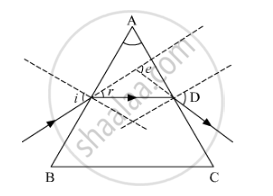
(a) ∠A and ∠i
(b) ∠A, ∠i and ∠r
(c) ∠A, ∠i, ∠e and ∠D
(d) ∠A, ∠i, ∠r and ∠D
When a beam of white light is passed through a prism, it splits to form lights of seven colours. Is it possible to recombine the lights of seven colours to obtain the white light again? Explain your answer.
In the figure given alongside, a narrow beam of white light is shown to pass through a triangular glass prism. After passing through the prism, it produces a spectrum YX on the screen.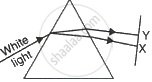
- State the colour seen
- at X, and
- at Y.
- Why do different colours of white light bend through different angles with respect to the incident beam of light?
A beam of white light is shone onto a glass prism. The light cannot be:
(a) deviated
(b) dispersed
(c) focused
(d) refracted
When a white light ray falls on a prism, the ray at its first surface suffers ______.
Write the range of wavelength of the infrared spectrum.
Sunlight entering through a narrow aperture falls on a prism. Draw a neat labelled ray diagram to show the formation of the spectrum on a screen. Name the colour obtained nearer the base of the prism.
Curved mirrors have surfaces that are spherical, cylindrical, parabolic, and ellipsoid.
dispersive power of crown glass? Given that µv = 1.5230, µr = 1.5145
Observe the given diagram and answer the questions:
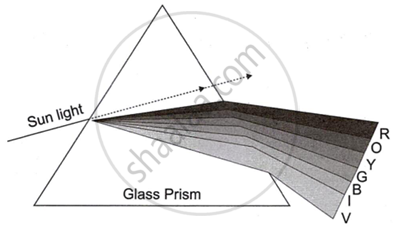
- Name the process shown in the figure.
- Name the colour that deviates the most.
- Name the colour that deviates the least.
- Name any one phenomenon in nature which is based on the above process.
- Define ‘spectrum’.
