Advertisements
Advertisements
प्रश्न
When a white light ray falls on a prism, the ray at its first surface suffers ______.
विकल्प
No refraction
Only dispersion
Only deviation
Both deviation and dispersion
Advertisements
उत्तर
When a white light ray falls on a prism, the ray at its first surface suffers both deviation and dispersion.
APPEARS IN
संबंधित प्रश्न
The path of a ray of light passing through a glass prism is shown below:
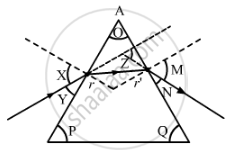
In this diagram, the angle of prism, angle of incidence, angle of emergence and angle of deviation, respectively, have been represented by:
(A) O, Y, Z and N,
(B) P, Y, M and Z,
(C) O, X, M and Z,
(D) P, X, Z and N.
Why do the component colours of incident white light split into a spectrum while passing through a glass prism, explain
A beam of white light falls on a glass prism. The colour of light which undergoes the least bending on passing through the glass prism is:
(a) violet
(b) red
(c) green
(d) blue
Out of the following, the colour of light having the maximum wavelength is:
(a) violet
(b) indigo
(c) green
(d) orange
In the spectrum of white light by a prism, the colour at the extreme end opposite to the base of prism is ______.
In the diagram, a narrow beam of white light is incident on a right-angled isosceles prism. The critical angle of the material of prism for the yellow colour of white light is 45°. Complete the diagram to show the path of blue, yellow, and red colours of white light till they emerge out of the prism.
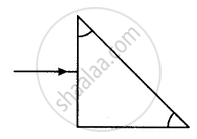
What is dispersion? Explain in detail.
The phenomena of light involved in the formation of rainbow are ______.
What is Newton’s disc?
When sunlight passes through water droplets in the atmosphere it gets dispersed into its constituent colours forming a rainbow. A similar phenomenon is observed when white light passes through a prism.
Which colour will show the maximum angle of deviation and which colour will show the minimum angle of deviation?
