Advertisements
Advertisements
प्रश्न
The path of a ray of light passing through a glass prism is shown below:
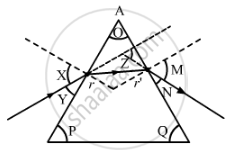
In this diagram, the angle of prism, angle of incidence, angle of emergence and angle of deviation, respectively, have been represented by:
(A) O, Y, Z and N,
(B) P, Y, M and Z,
(C) O, X, M and Z,
(D) P, X, Z and N.
Advertisements
उत्तर
O is the angle of prism.
Angle of incidence is the angle made by the incident ray with the normal to the surface of the prism. Here, X represents the angle of incidence.
Angle of emergence is the angle made by the emerging ray with the normal to the surface of the prism. Here, Mrepresents the angle of emergence.
Angle of deviation is the angle made by the emerging ray with the incident ray. Here, Z represents the angle of deviation.
Hence, the correct option is C.
APPEARS IN
संबंधित प्रश्न
A beam of white light is shone onto a glass prism. The light cannot be:
(a) deviated
(b) dispersed
(c) focused
(d) refracted
The speed of light in air or vacuum is
In the spectrum of white light by a prism, the colour at the extreme end opposite to the base of prism is ______.
A wave has wavelength 50Å of State its one use.
The phenomenon of splitting of light into its component colours is ___________ .
Write three conditions necessary to obtain a pure spectrum on a screen. Name the instrument in which the conditions stated by you are fulfilled.
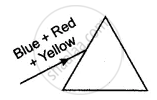
In the figure, a beam of light consisting of three colours blue, red, and yellow is incident on a prism and on a rectangular glass block respectively. Complete the diagram by drawings of the refracted and emergent rays.
The phenomena of light involved in the formation of rainbow are ______.
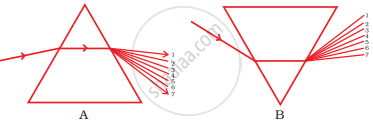
State the correct sequence (1-7) of colours in the spectrum formed by the prisms A and B, shown in the following figure.
A prism of refractive index `sqrt2` and refracting angle A produces minimum deviation δm of a ray on one face at an angle of incidence 45°, The values of A and δm are, respectively ______.
