Advertisements
Advertisements
प्रश्न
The phenomenon of splitting of light into its component colours is ___________ .
Advertisements
उत्तर
The phenomenon of splitting of light into its component colours is dispersion.
APPEARS IN
संबंधित प्रश्न
The path of a ray of light passing through a glass prism is shown below:
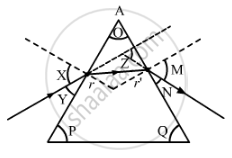
In this diagram, the angle of prism, angle of incidence, angle of emergence and angle of deviation, respectively, have been represented by:
(A) O, Y, Z and N,
(B) P, Y, M and Z,
(C) O, X, M and Z,
(D) P, X, Z and N.
- A ray of white light breaks up into its components while passing through a glass prism. Draw a ray diagram to show the path of rays.
- Mark the least deviated colour in your diagram.
- Why do different coloured rays deviate differently in a prism?
In the figure given alongside, a narrow beam of white light is shown to pass through a triangular glass prism. After passing through the prism, it produces a spectrum YX on the screen.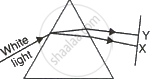
- State the colour seen
- at X, and
- at Y.
- Why do different colours of white light bend through different angles with respect to the incident beam of light?
Draw a diagram to show the refraction of light through a glass prism. On this diagram, mark
(i) incident ray
(ii) emergent ray, and
(iii) angle of deviation.
Name the process which is involved in the formation of a rainbow.
The splitting up of white light into seven colours on passing through a glass prism is called ______.
The coloured light having the maximum speed in glass prism is ______.
The splitting of white light into its constituent colours is called .............
A ray of white light falls on a prism. Draw a ray diagram to show that the prism disperses the white light.
The frequency range of visible light is from 3.75 × 10¹⁴ Hz to 7.5 × 10¹⁴ Hz. Calculate its wavelength range. Take speed of light = 3 × 10⁸ m/s.
In the following diagram, the correctly marked angles are
(A) All
(B) Only ∠i and ∠A
(C) ∠i, ∠r and ∠A
(D) ∠i, ∠A and ∠D
In which of the following four diagrams is the correct path of a ray of light passing through a glass prism shown ?
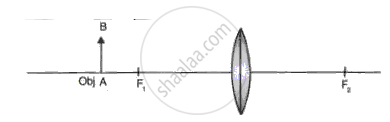
An object AB is placed in front of a convex lens as shown in fig. 4. Complete the ray diagram and obtain the image formed and state the nature of the image.
An object is placed in front of a converging lens and in front of a diverging lens as in fig.
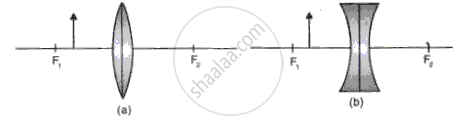
(a)Complete the ray diagram to obtain an image.
(b)Compare the nature of image formed by both the lenses in the above case.
Suggest one way, in each case, by which we can detect the presence of Infrared radiations.
The periscope is an optical device with a polished surface that reflects the light falling on it.
A prism of refractive index `sqrt2` and refracting angle A produces minimum deviation δm of a ray on one face at an angle of incidence 45°, The values of A and δm are, respectively ______.
In the following diagram showing dispersion of white light by a glass prism, the colours 'P' and 'Q’ respectively are:

