Advertisements
Advertisements
प्रश्न
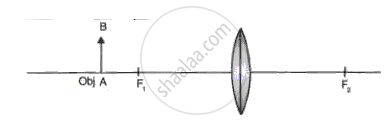
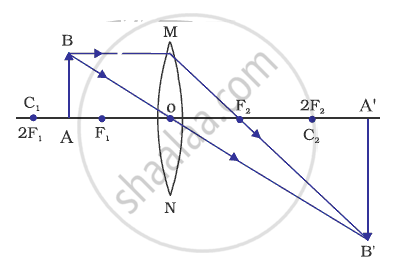
An object AB is placed in front of a convex lens as shown in fig. 4. Complete the ray diagram and obtain the image formed and state the nature of the image.
Advertisements
उत्तर
Nature of image: Real, inverted and magnified.
APPEARS IN
संबंधित प्रश्न
Describe an activity to show that colours of white light splitted by a glass prism can be recombined to get white light by another identical glass prism. Also draw ray diagram to show the recombination of the spectrum of white light.
A student is observing a diagram showing the path of a ray of light passing through a glass prism. He would find that for all angles of incidence the ray of light bends:
Draw a ray diagram to explain the term angle of deviation.
In the formation of spectrum of white light by a prism:
- which colour is deviated least?
- which colour is deviated most?
What do you understand by the term spectrum? Name the various colours present in the spectrum of sunlight.
While performing the experiment to trace the path of a ray of light passing through a glass prism, four students marked the incident ray and the emergent ray in their diagrams in the manner shown below. 
(A) I
(B) II
(C) III
(D) IV
A student has to trace the path of a ray of light through a glass prism. List four precautions he should observe for better results.
Write the range of wavelength of the infrared spectrum.
Name the scientist who was the first to use a glass prism to obtain the spectrum of sunlight.
The periscope is an optical device with a polished surface that reflects the light falling on it.
