Advertisements
Advertisements
प्रश्न
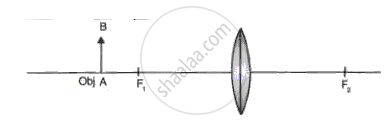
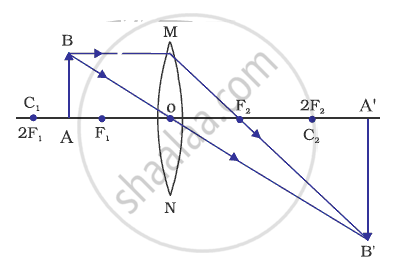
An object AB is placed in front of a convex lens as shown in fig. 4. Complete the ray diagram and obtain the image formed and state the nature of the image.
Advertisements
उत्तर
Nature of image: Real, inverted and magnified.
APPEARS IN
संबंधित प्रश्न
Draw a ray diagram to explain the term angle of deviation.
Study the following ray diagram:
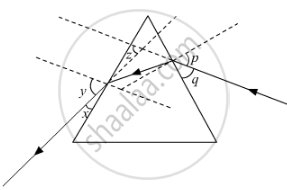
In this diagram, the angle of incidence, the angle of emergence and the angle of deviation respectively have been represented by
(A) y, p, z
(B) x, q, z
(C) p, y, z
(D) p, z, y
What are the seven colours seen in a rainbow?
The splitting of white light into its constituent colours is called .............
The property of splitting of white light into its seven constituent colours is known as
Observe the given figure and write appropriate phenomenon of light in the box.
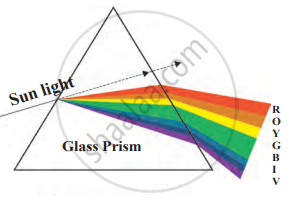
The splitting of white light in to seven colors is called ______.
Name the scientist who was the first to use a glass prism to obtain the spectrum of sunlight.
Assertion: We can see the rainbow in the sky when the rain starts falling after a spell of bright sunlight.
Reason: The rainbow is formed due to the dispersion of light.
Observe the given diagram and answer the questions:
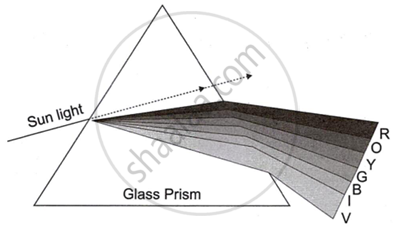
- Name the process shown in the figure.
- Name the colour that deviates the most.
- Name the colour that deviates the least.
- Name any one phenomenon in nature which is based on the above process.
- Define ‘spectrum’.
