Advertisements
Advertisements
प्रश्न
Observe the given diagram and answer the questions:
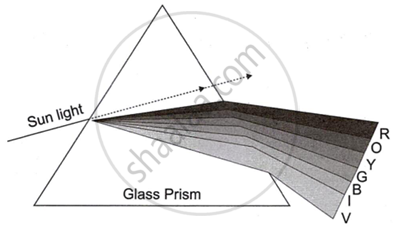
- Name the process shown in the figure.
- Name the colour that deviates the most.
- Name the colour that deviates the least.
- Name any one phenomenon in nature which is based on the above process.
- Define ‘spectrum’.
Advertisements
उत्तर
- The process shown in the figure is the dispersion of light.
- The colour that deviates the most is violet.
- The colour that deviates the least is red.
- One phenomenon in nature based on the above process is the formation of a rainbow.
- A spectrum is a band of colours, as seen in a rainbow, produced by the separation of the components of light by their different degrees of refraction according to wavelength.
APPEARS IN
संबंधित प्रश्न
What happens when a ray of ordinary light is passed through a triangular glass prism?
How could you show that the colours of the spectrum combine to give white light?
Which is refracted most by a prism : red light or violet light? Explain why?
The colour of white light which suffers the maximum bending (or maximum refraction) on passing through a glass prism is:
(a) yellow
(b) orange
(c) red
(d) violet
The colour of white light which is deviated the maximum on passing through the glass prism is:
(a) blue
(b) indigo
(c) red
(d) orange
Which of the following coloured light has the least speed in glass prism?
(a) violet
(b) yellow
(c) red
(d) green
State the speed of light in (a) air, (b) water, and (c) glass
Which is optically denser: water or air? Give reason
A ray of white light falls on a prism. Draw a ray diagram to show that the prism disperses the white light.
A ray of white light is passed through a glass prism and a spectrum is obtained on a screen.
- Name the seven colours of the spectrum in order.
- Do the colours have the same width in the spectrum?
- Which of the colour of the spectrum of white light deviates (i) the most, (ii) the least?
In the following diagram, the correctly marked angles are
(A) All
(B) Only ∠i and ∠A
(C) ∠i, ∠r and ∠A
(D) ∠i, ∠A and ∠D
Draw a labeled ray diagram to illustrate the dispersion of a narrow beam of white light when it passes through a glass prism.
Distinguish between an impure spectrum and a pure spectrum.
Write the range of wavelength of the visible spectrum.
Match the Columns:
| Column ‘A’ | Column ‘B’ |
| The wavelength of red light | (a) 600 nm |
| (b) 700 nm | |
| (c) 500 nm |
When white light enters a glass prism from the air, the angle of deviation is least for ____________.
State the correct sequence (1-7) of colours in the spectrum formed by the prisms A and B, shown in the following figure.
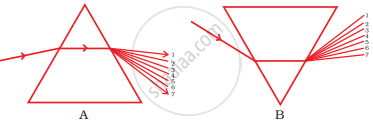
In dispersion, the color of light that will bend more is ______.
During dispersion of white light by prism placed in air, for a particular value of angle of prism,
A ray of light is incident at 45° on an equilateral prism in the diagram below.

- Name the phenomenon exhibited by the ray of light when it enters and emerges out of the prism.
- State the cause of the above phenomenon mentioned by you.
