Advertisements
Advertisements
प्रश्न
A ray of white light falls on a prism. Draw a ray diagram to show that the prism disperses the white light.
Advertisements
उत्तर

APPEARS IN
संबंधित प्रश्न
Study the following diagrams in which the path of a ray of light passing through a glass prism as traced by four students P, Q, R and S is shown:

The student who has traced the path correctly is
(A) P
(B) Q
(C) R
(D) S
In the figure given alongside, a narrow beam of white light is shown to pass through a triangular glass prism. After passing through the prism, it produces a spectrum YX on the screen.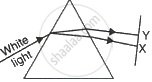
- State the colour seen
- at X, and
- at Y.
- Why do different colours of white light bend through different angles with respect to the incident beam of light?
Draw a diagram to show the refraction of light through a glass prism. On this diagram, mark
(i) incident ray
(ii) emergent ray, and
(iii) angle of deviation.
What acts as tiny prisms in the formation of a rainbow?
A beam of white light is shone onto a glass prism. The light cannot be:
(a) deviated
(b) dispersed
(c) focused
(d) refracted
Write three conditions necessary to obtain a pure spectrum on a screen. Name the instrument in which the conditions stated by you are fulfilled.
Why do we see a rainbow in the sky only after rainfall?
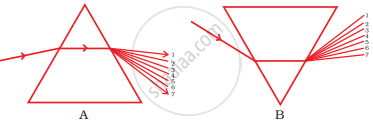
State the correct sequence (1-7) of colours in the spectrum formed by the prisms A and B, shown in the following figure.
Assertion: We can see the rainbow in the sky when the rain starts falling after a spell of bright sunlight.
Reason: The rainbow is formed due to the dispersion of light.
