Advertisements
Advertisements
प्रश्न
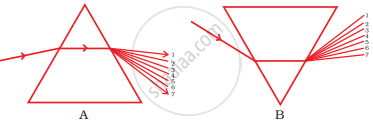
State the correct sequence (1-7) of colours in the spectrum formed by the prisms A and B, shown in the following figure.
Advertisements
उत्तर
In figure A and figure B
| Figure A | Colour | Figure B |
| 1 | Red | 7 |
| 2 | Orange | 6 |
| 3 | Yellow | 5 |
| 4 | Green | 4 |
| 5 | Blue | 3 |
| 6 | Indigo | 2 |
| 7 | Violet | 1 |
APPEARS IN
संबंधित प्रश्न
What will happen if another similar glass prism is placed upside down behind the first prism?
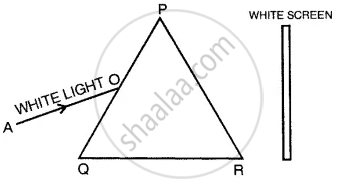
In figure AO is the ray of white light falling on a prism PQR. Complete the diagram till the light emerges out from the prism and falls on the screen.
- A beam of monochromatic light undergoes minimum deviation through an equiangular prism, how does the beam pass through the prism, with respect to its base?
- If white light is used in the same way as in part (a) above, what change do you expect in the emergent beam?
- What conclusion do you draw about the nature of white light in part (b)?
A ray of white light is passed through a glass prism and a spectrum is obtained on a screen.
- Name the seven colours of the spectrum in order.
- Do the colours have the same width in the spectrum?
- Which of the colour of the spectrum of white light deviates (i) the most, (ii) the least?
An object is placed in front of a converging lens and in front of a diverging lens as in fig.
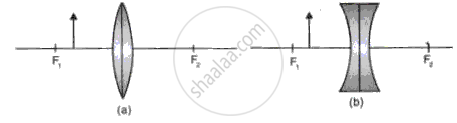
(a)Complete the ray diagram to obtain an image.
(b)Compare the nature of image formed by both the lenses in the above case.
Differentiate between a glass slab and a glass prism.
State two uses of ultraviolet radiation.
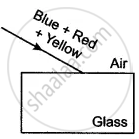
In the figure, a beam of light consisting of three colours blue, red, and yellow is incident on a prism and on a rectangular glass block respectively. Complete the diagram by drawings of the refracted and emergent rays.
Match the Columns:
| Column ‘A’ | Column ‘B’ |
| The wavelength of red light | (a) 600 nm |
| (b) 700 nm | |
| (c) 500 nm |
The splitting of white light into its component colours is called ____________.
