Advertisements
Advertisements
प्रश्न
When we place a glass prism in the path of a narrow beam of white light a spectrum is obtained. What happens when a second identical prism is placed in an inverted position with respect to the first prism? Draw a labelled ray diagram to illustrate it.
Advertisements
उत्तर
The first prism disperses white light into its seven constituent colours and forms the spectrum. The other inverted prism recombines all the seven colors and gives a white light.
संबंधित प्रश्न
Study the following figure in which a student has marked the angle of incidence (∠i), angle of refraction (∠r), angle of emergence (∠e), angle of prism (∠A) and the angle of deviation (∠D). The correctly marked angles are
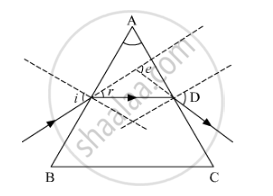
(a) ∠A and ∠i
(b) ∠A, ∠i and ∠r
(c) ∠A, ∠i, ∠e and ∠D
(d) ∠A, ∠i, ∠r and ∠D
State the cause of dispersion of white light passing through a glass prism. How did Newton show that white light of sun contains seven colours using two identical glass prisms. Draw a ray diagram to show the path of light when two identical glass prisms are arranged together in inverted position with respect to each other and a narrow beam of white light is allowed to fall obliquely on one of the focus of the first prism.
Why do the component colours of incident white light split into a spectrum while passing through a glass prism, explain
What acts as tiny prisms in the formation of a rainbow?
When a white light ray falls on a prism, the ray at its first surface suffers ______.
While performing the experiment to trace the path of a ray of light passing through a glass prism, four students marked the incident ray and the emergent ray in their diagrams in the manner shown below. 
(A) I
(B) II
(C) III
(D) IV
If a monochromatic beam of light undergoes minimum deviation through an equiangular prism, how does the beam pass through the prism, with respect to its base?
A wave has wavelength 50Å of State the speed in vacuum.
The periscope is an optical device with a polished surface that reflects the light falling on it.
In the following diagram showing dispersion of white light by a glass prism, the colours 'P' and 'Q’ respectively are:

