Advertisements
Advertisements
प्रश्न
When a white light ray falls on a prism, the ray at its first surface suffers ______.
पर्याय
No refraction
Only dispersion
Only deviation
Both deviation and dispersion
Advertisements
उत्तर
When a white light ray falls on a prism, the ray at its first surface suffers both deviation and dispersion.
APPEARS IN
संबंधित प्रश्न
A student traces the path of a ray of light through a triangular glass prism for different values of angle of incidence. On analyzing the ray diagrams, which one of the following conclusions is he likely to draw?
(A) The emergent ray is parallel to the incident ray.
(B) The emergent ray bends at an angle to the direction of the incident ray.
(C) The emergent ray and the refracted ray are at right angles to each other.
(D) The emergent ray is perpendicular to the incident ray.
In the following diagram the correctly marked angles are :

(a) ∠A and ∠e
(b) ∠i, ∠A and ∠D
(c) ∠A ∠r and ∠e
(b) ∠A ∠r and ∠D
State the speed of light in (a) air, (b) water, and (c) glass
Define the term dispersion of light.
While performing the experiment to trace the path of a ray of light passing through a glass prism, four students marked the incident ray and the emergent ray in their diagrams in the manner shown below. 
(A) I
(B) II
(C) III
(D) IV
If a monochromatic beam of light undergoes minimum deviation through an equiangular prism, how does the beam pass through the prism, with respect to its base?
In the figure, a beam of light consisting of three colours blue, red, and yellow is incident on a prism and on a rectangular glass block respectively. Complete the diagram by drawings of the refracted and emergent rays.
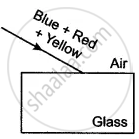
Write an Explanation.
Critical angle
What is dispersion? Explain in detail.
Which one of the following is involved for the formation of rainbow in the sky?
