Advertisements
Advertisements
प्रश्न
Define the term dispersion of light.
Define dispersion of light.
Advertisements
उत्तर १
The phenomenon of the splitting of white light by a prism into its constituent colours is known as dispersion of light.
उत्तर २
When a beam of white light or composite light is refracted through any transparent media such as glass or water, it is split into its component colours. This phenomenon is called ‘dispersion of light’.
APPEARS IN
संबंधित प्रश्न
Describe an activity to show that colours of white light splitted by a glass prism can be recombined to get white light by another identical glass prism. Also draw ray diagram to show the recombination of the spectrum of white light.
In the following diagram the correctly marked angles are :

(a) ∠A and ∠e
(b) ∠i, ∠A and ∠D
(c) ∠A ∠r and ∠e
(b) ∠A ∠r and ∠D
Draw a ray diagram to show the dispersion of white light.
What is spectrum?
In the figure given alongside, a narrow beam of white light is shown to pass through a triangular glass prism. After passing through the prism, it produces a spectrum YX on the screen.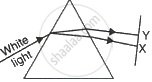
- State the colour seen
- at X, and
- at Y.
- Why do different colours of white light bend through different angles with respect to the incident beam of light?
What acts as tiny prisms in the formation of a rainbow?
Which is optically denser: water or air? Give reason
The diagram below shows the path taken by a narrow beam of yellow monochromatic light passing through an equiangular glass prism. If the yellow light is replaced by a narrow beam of white light incident at the same angle, draw another diagram to show the passage of white light through the prism and label it to show the effect of prism on the white light.

What conclusion do you draw about the nature of white light in part (b)?
A ray of white light is passed through a glass prism and a spectrum is obtained on a screen.
- Name the seven colours of the spectrum in order.
- Do the colours have the same width in the spectrum?
- Which of the colour of the spectrum of white light deviates (i) the most, (ii) the least?
In an experiment to trace the path of a ray of light through a triangular glass prism, a student would observe that the emergent ray
(a) is parallel to the incident ray.
(b) is along the same direction of incident ray.
(c) gets deviated and bends towards the thinner part of the prism.
(d) gets deviated and bends towards the thicker part (base) of the prism.
If white light is used in same way what change is expected in the emergent beam?
Draw a labelled diagram: Dispersion of light through a prism.
Write the range of wavelength of the ultraviolet spectrum.
Sunlight entering through a narrow aperture falls on a prism. Draw a neat labelled ray diagram to show the formation of the spectrum on a screen. Name the colour obtained nearer the base of the prism.
Which of the following is a natural phenomenon which is caused by the dispersion of sunlight in the sky?
The periscope is an optical device with a polished surface that reflects the light falling on it.
When sunlight passes through water droplets in the atmosphere it gets dispersed into its constituent colours forming a rainbow. A similar phenomenon is observed when white light passes through a prism.
Which colour will show the maximum angle of deviation and which colour will show the minimum angle of deviation?
