Advertisements
Advertisements
प्रश्न
Define the term dispersion of light.
Define dispersion of light.
Advertisements
उत्तर १
The phenomenon of the splitting of white light by a prism into its constituent colours is known as dispersion of light.
उत्तर २
When a beam of white light or composite light is refracted through any transparent media such as glass or water, it is split into its component colours. This phenomenon is called ‘dispersion of light’.
APPEARS IN
संबंधित प्रश्न
As light rays pass from air into a glass prism, are they refracted towards or away from the normal?
What will happen if another similar glass prism is placed upside down behind the first prism?
Make two diagrams to explain refraction and dispersion.
Out of the following, the colour of light having the maximum wavelength is:
(a) violet
(b) indigo
(c) green
(d) orange
Explain the cause of dispersion of white light through a prism.
In the spectrum of white light by a prism, the colour at the extreme end opposite to the base of prism is ______.
While performing the experiment to trace the path of a ray of light passing through a glass prism, four students marked the incident ray and the emergent ray in their diagrams in the manner shown below. 
(A) I
(B) II
(C) III
(D) IV
Draw a labeled ray diagram to illustrate the dispersion of a narrow beam of white light when it passes through a glass prism.
State two uses of ultraviolet radiation.
What do you understand by spectrum? Name the seven prominent colours in order, as obtained in the spectrum of white light.
Match the Columns:
| Column ‘A’ | Column ‘B’ |
| The wavelength of red light | (a) 600 nm |
| (b) 700 nm | |
| (c) 500 nm |
Draw a neat and labelled diagram for dispersion of light.
Observe the given figure and write appropriate phenomenon of light in the box.
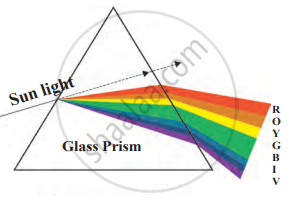
Observe the given figure and answer the following questions.
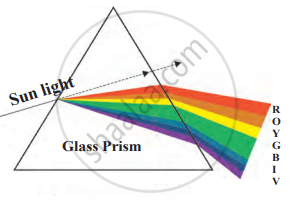
- Which colour light rays bend most?
- Which colour light rays bend least.
- What is the wavelength of violet light rays?
Which of the following is a natural phenomenon which is caused by the dispersion of sunlight in the sky?
Name the scientist who was the first to use a glass prism to obtain the spectrum of sunlight.
A ray of light is incident at 45° on an equilateral prism in the diagram below.

- Name the phenomenon exhibited by the ray of light when it enters and emerges out of the prism.
- State the cause of the above phenomenon mentioned by you.
